Showing posts with label Combined Heat and Power. Show all posts

Saturday, November 07, 2015

CHP and 3 Important Considerations When Designing Combined Heat and Power Systems

An Introduction to CHP
Add caption
Combined heat and power (CHP) systems, are also known as cogeneration systems, and they greatly improve the usable energy output from electricity generation systems. When a gas engine or turbine is used to generate electricity without CHP, after the electricity leaving the site, there is also hot "cooling water" that is used to keep the jacket around the engine and generator windings cool.

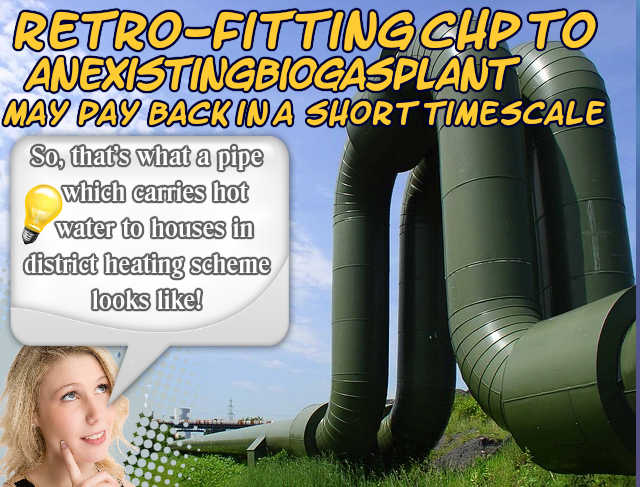
Usually, this heat energy is not used, and goes to a cooling plant, which is usually primarily a radiator and a fan based cooler which vents the heat to the atmosphere. In CHP (combined heat and power) systems, that heat is used in some way, and the most common method is to send the hot water through an insulated pipeline to a space heating radiator in a remote office, or factory, or the hot water delivered may be used to warm more water for industrial hot water uses. The result is that CHP provides a lot more useful thermal energy in an integrated system.

This means that CHP is not a technology, but a concept, there are many ways to apply different technologies to CHP. Heat is used when it would otherwise be wasted during the normal methods of separate generation of heat and power. It is hard to appreciate just how big the benefits of anaerobic digestion heat CHP can be. Experts say that the conventional methods of producing usable heat and power separately usually achieves no better than a combined efficiency of use of the original energy output of 45%, amazingly CHP systems operate at levels as close to 80%. Just stop to think for a moment now, just how wasteful the normal method is.

3 Important Considerations When Designing Combined Heat and Power Systems

  1. Payoffs for adding CHP to an existing biogas generation plant installation can be fast, and as quick as 12 to 18 months, but not always. It is essential to do some detailed analysis of the true value of the heat you will gain from installing heat exchangers to output this useful hot water. The heat (hot water) from any CHP system is only going to be as hot as it now enters the cooling system. Check that this will be hot enough for the purpose the hot water, or heat will be used. For space heating it is usually fine, but just remember that it will not be hotter than the cooling jacket temperature.
  2. Next check the synergy of time. The hot water produced will need to be output at the times when it is needed. For example, if the heat is to be used for crop drying, does the crop drying requirement coincide seasonally with the usage of the generation equipment? That output may be used, in some cases, only at times when the electricity company pays the best rate each day for the power. Conflicts of this sort are likely to occur, and this is not a problem as long as the calculation of the value of the CHP power is done in a way that makes due allowance for them. Although there may be on-farm uses they may prove to give a lower payback than for instance installing a longer insulated pipeline to a nearby factory which has a 24/7 demand for hot process water.
  3. Make sure that you also make a realistic evaluation of the current costs of the power that the CHP energy source would replace. At the current time of writing, electricity tariffs and diesel costs per litre have been dropping due to the low cost of oil. Take a view on the extent to which that drop may continue and build-in a margin for a further potential drop, making sure that the investment decision takes a cautious approach.


You may also find the following article useful:

The Biogas Engine – Defined And How They Provide Biogas Generation of Electricity

There are a number of advanced and proven gas engines utilized for biogas generation by the biogas generator manufacturers. They are maximized for biogas use, in a way that ensures that their combustion chambers provide the highest degree of performance possible.

Lubricating oil is dispersed throughout the engine’s moving components to keep the tool running smoothly as well as to lower wear. Proper treatment and also upkeep of the generator engine will certainly guarantee many years of problem complimentary usage.

Nevertheless, failure to deal with normal upkeep is a sure means to attractive trouble. This is definitely real when it comes to the engine’s lubricating oil.

The post The Biogas Engine – Defined And How They Provide Biogas Generation of Electricity appeared first on Anaerobic Digestion Community Website.

via The Biogas Engine – Defined And How They Provide Biogas Generation of Electricity

Monday, June 14, 2010

TESCO Shopping Complex to be Powered by Food Using Anaerobic Digestion

The power of food

Supermarket giant TESCO'S new distribution centre in Widnes is to be completely powered by renewable energy generated from food waste, they have announced.

It has joined with with transport company Stobart Croup, and food waste recycling experts the PDM Croup in a move that will see the new shopping centre take its renewable energy from PDM's combined heat and power (CHP) plant that turns 230,000 tonnes of food waste, including Tesco's unwanted, into green renewable heat and electricity. The retailing company is already working with PDM which recycles all Tesco's meat waste at present.

There are no losses in the cable route either as the power is sent via their own cable link which provides renewable energy direct from the CHP plant to the neighbouring distribution centre.

Tesco has leased the new 528,000 sq.ft. distribution centre, which will see its first customers this summer, to provide increased capacity to service its growing network of stores in the north west of England.

Juliette Bishop, Tesco's corporate affairs manager, said:
"This venture is an ideal example of how sustainability is at the very core of the Tesco business and it's great that we can demonstrate that our food waste is directly providing power back into our operations, helping us to reduce waste going to landfill and our carbon footprint."

Stobart and PDM will work together to offer Stobart's customer-base comprised of predominantly food retailers, a recycling service. The agreement would see food waste taken in return journey loads, on Stobart vehicles, to Widnes.

The Widnes plant recycles more than 230,000 tonnes of biomass fuels a year to generate renewable combined heat and power using biomass-to-energy technology.

The fuel is derived from food and other bio-wastes produced from every stage of the food chain, from farm to dinner plate.

PDM Croup director Robert Ratcliffe explained:

"Using green power is becoming an important objective for many businesses, however it's extremely rare that such power can come directly from anywhere other than the National Grid. This type of closed-loop biomass-to-energy relationship is rare in the UK and it's great that we can work together to not only help bolster green credentials, but also enable Tesco to demonstrate that any food waste it generates is essentially helping to power its own supply chain."

Sunday, February 28, 2010

Prospects for Anaerobic Digestion Remain Positive Despite Failure of Copenhagen Climate Summit

A recent article in the New Civil Engineer magazine, the magazine of the UK’s Institution of Civil Engineers, discusses how now after the failure of the Copenhagen Climate Summit it will be possible to rise to the challenge of complying with UK carbon reduction pledges.

You only have to read the following paragraphs from the above NCE article to realise the enormity of the task ahead even for just the water industry:

The UK government has pledged that emissions of greenhouse gases will be cut by 80% C02 equivalent - measured against 1990 levels - within the next 40 years.

Yet over the same time Britain's population is expected to grow by anywhere from 15% to 30%, per capita water use is rising and it is likely the [water] industry will be required to meet higher quality and environmental standards - all driving up energy consumption. How are companies going to square the circle?

As readers of my Anaerobic Digestion blog, I am sure that you will not want me to dwell upon the negatives, such as the fact that so far almost all we have seen so far has been rhetoric, while UK carbon emissions have continued to rise.

This is despite that fact that we have exported so much of our emissions as our manufacturing industry has declined, in favour of imports. Even the water industry admits to a 10% rise in carbon emissions since 2000.

So, where will we find the huge cuts needed? We will clearly have to go far beyond efficiency savings which might optimistically, for example, within the water industry provide 30% to 45% savings given the right (high) levels of investment needed.

Opportunities to cut carbon further do undoubtedly exist, and to quote the 14 January 2010 NCE article, for the UK Water Industry example, these might comprise:

  • demand reduction
  • improved design
  • adoption of new technologies
  • operational improvements
  • better management of catchments and drainage systems and
  • wider use of renewable energy.

Now those that have experience of Anaerobic Digestion will know that with present technology the potential for the AD industry to provide renewable energy is large enough to be worthwhile, but not that big. Even with a very high rate of adoption AD will not provide enough power to meet the demand as a major contributor to the 80% reduction target. To do that would need a technical revolution.

But, again quoting from the NCE article, Ofwat’s head of Climate Change Policy Mike Keil has said that:

“Looking at the next five to ten years you can say with some certainty there won't be a technical revolution. Certainly there will be innovation contributing to carbon reductions, but not a huge step change".

Beyond 2020 it is possible there will be breakthroughs as research and development bears fruit and new technologies come to maturity.

So, based on current technologies, an 80% reduction looks extremely difficult, if not verging on impossible, to achieve. The lack of hard commitments from the Copenhagen Summit contributes to a feeling that the political commitment to “pledges” far outweighs the ability to deliver, given the enormity of the task ahead.

Nevertheless, it is important that Engineers do push forward where this can be done on the basis of economically justifiable results. That is where the prospects for UK Anaerobic Digestion do look very good indeed.

Again, referring to the Water Industry; In the next investment period the UK water companies will be making the most of the opportunities offered by enhanced sewage sludge digestion technologies to generate high calorific biogas and reduce the final volume of biosolids as waste for disposal. Adding hydrolysis up front before the digester will help to greatly increase the amount of conversion of the total biomass in sludge to methane, for example.

Another development to continue will be that:

"By using biogas to drive combined heat and power engines, enhanced biodigestion offers potential to make sewage treatment works energy self-sufficient," 

says Mott MacDonald head of water regulation Andrew Heather [again quoted here from the NCE article].

Some companies, we are told, are also planning to clean-up biogas so that it can be used as a vehicle fuel or sold into the national gas grid. It will be interesting to report on that in this blog in due course.

In addition to the digestion of their own sewage works sludge some Water Companies are also, we are told, looking to increase energy from biodigestion by supplementing sewage sludge with food and industrial waste.

So, the prospects for Anaerobic Digestion are good, but the big question mark, which continues to become more urgent to answer remains.

Where will the rest of these carbon savings come from, which are so badly needed to plug the huge gap between current reality and an 80% saving?

Monday, June 29, 2009

Major UK Water Company’s Invests in Anaerobic Digestion of Sewage Sludge


The following article is based on an extract of Wet News (November 2008) the original article is about work done by May Gurney to refurbish and improve the current Severn Trent Coalport, Newport and Monkmoor, anaerobic digesters which digest sewage sludge:

AS NEW energy and environmental directives come into action, the UK sewage treatment industry is increasingly under the spotlights.

Many examples of renewable energy projects by the gigantic water firms and their framework partners are reported to be on their way which will be almost guaranteed to draw much interest from politicians, rivals and the public. Combined heat and power (CHP) is at the forefront in the UK Water Industry, manufacturing heat and electricity from a single input source that might otherwise be burned off as waste.
Severn Trent Water and May Gurney completed an intensive project to install new anaerobic digestion technology on 3 of Severn Trent's sites. The water company has been working in cooperation with contractor May Gurney, a consultant in biogas optimisation, which has been carrying out these works since 2007.

Last summer when the article was writted it was getting near completion on the last site located at Coalport, Shropshire. The other 2 sites, at Newtown ( Powys ) and Monkmoor, Shrewsbury ( Shropshire ), were handed back this summer and are manufacturing biogas from their improved digester systems and using it to fuel CHP units.

The work at Newtown, Monkmoor and Coalport has enabled the sites to scale back their carbon footprints and produce green energy. Doing so will also prove very much a bargain as Severn Trent will become more self-sufficient and save heavily on external energy suppliers' ever growing costs.

At Coalport alone, the median daily sludge feed to the digesters is 129m3, which produces a mean of 2,640m3 of biogas each day - enough to power the on-site CHP units that generate electricity to run the site as well as the heat to operate the boilers and continue the digestion process.

The authors of the article see a huge future for biogas.
"For all the same environmental, legislative and commercial reasons that have inspired Severn Trent Water, others will certainly follow suit," and they are saying, much more positive things about Anaerobic Digestion, as follows:

"We are happy about the possibilities for expansion and development in this area. A complete industry is expanding round the re-emergence of anaerobic digestion, which enables waste material, eg food waste, to be used as a resource to provide replenish-able energy.”

"The giant increase in available volumes of biogas, rising oil costs, increasing demand for new renewable fuels and bio energy will excite investment in biogas utilization technologies which will see biogas refining to be used as auto fuels or injection into the nation's grid.”

"This latter opportunity will definitely not have escaped the notice of water firms. While sites with anaerobic digestion processes already benefit from self-sufficiency by manufacturing their own energy, we need only look to states like Sweden to see examples of how extra revenue can be generated by selling electricity and bio-methane and at the same time make a contribution to govt. climate change, waste management and wider environmental objectives."

In the field of renewable resources the authors say that Severn Trent is sure to be at the forefront as the industry moves in this direction. As the number 1 producer of renewable energy in the water sector, Severn Trent is progressing with its investment programme to further develop greener energy.

Having set itself the target of just about doubling self-generation from renewable resources to thirty percent of its total energy use by 2013, Severn Trent has clear plans to develop usage of existing technologies as well as introduce new and emerging technologies.

Severn Trent operates thirty CHP plants across its area using methane gas produced from the sewage treatment process. In 2005, this accounted for 51 percent of all clean energy derived from sewage gas in the United Kingdom and about 1.3% of all clean energy generated in the United Kingdom.

Current investment plans are reported to include schemes to increase the use of CHP plants across the region, install more water turbines in its dams, generate power from energy crops, and generate power from turbines at acceptable locations.

Furthemore, that investment is reported to be ongoing as a consequence of the success of the Monkmoor, Newtown and Coalport projects, the company has, we undertand, been in advanced talks with May Gurney about another 9 CHP projects.

More about May Gurney.

Thursday, November 13, 2008

UK Energy Bill to Include Renewable Heat Incentive

The Energy Bill received its third reading in the House of Lords on 5 November 2008 and includes proposals from the Department for Energy and Climate Change for a scheme to incentivise investment in renewable heat. Currently, energy used for heating accounts for just under half of all the UK’s carbon dioxide emissions, while only 0.6% of heat generated in the UK is derived from renewable sources.

The Government has been considering for some time how to reduce heat-related emissions and boost heat generation from renewable sources. Earlier this year, the Government issued a Call for Evidence on Heat (see our related Law-Now) and sought views on introducing a financial incentive to encourage heat from renewable sources in Chapter 4 of its consultation on the UK Renewable Energy Strategy (see Law-Now).

The amendments to the Energy Bill will enable a scheme to provide financial support to any supplier of renewable heat. Support may also be available to producers of biogas or biomethane or to producers of biofuel used for generating heat. The scheme will provide a welcome boost to renewable CHP (Combined Heat and Power) producers and the bio-waste industry, among others.

Key points to note are:

- There is flexibility to band the level of support according to the technology used for generating heat.
- Eligible renewable heat sources for the scheme are biomass, biofuels, fuel cells, water (including waves and tides), solar power, geothermal sources, heat from air, water or the ground and combined heat and power systems (using a renewable fuel only).
- There is no specified limit on the size of plant which will be eligible for support, as the scheme is intended to cover both domestic and industrial scale projects.
- The scheme will be financed by fossil fuel suppliers, perhaps through a levy which would be administrated by Ofgem.

The amendments to the Energy Bill do not contain information on when the scheme will come into force, but the government has acknowledged it would take at least 18 months to develop the details of the scheme and implement the necessary secondary legislation.

The Government’s consultation expected later in November as part of the development of its Heat and Energy Efficiency Strategy is likely to provide a forum to develop the details of the scheme. In that consultation, the governement will consider the issue of heat in the round from a low carbon, renewable and CHP perspective, as well as links to energy efficiency, notes Hergen Haye, the Director for Heat Policy at DECC.

The Energy Bill now only requires the House of Commons to approve the Lords’ amendments before receiving royal assent.

Thursday, February 08, 2007

EU Incineration Debate: How Will it Affect Adoption of Anaerobic Digestion?

Incineration efficiency warning ahead of EU waste debate

Local authorities planning to use incinerators to divert waste away from landfill should check that proposals meet forthcoming EU energy efficiency criteria.

The warning which essentaily fires a shot across the bows of those promoting Incineration without Combined Heat and Power, came ahead of next week's European Parliament vote in Strasbourg, on a Directive that could shape the next 50 years of EU policy on waste management (Read the full article at letsrecycle.com news).

Carbon Emissions

Dr Jackson said she was fully supportive of more incineration being used, provided it was efficient. She derided the "out of date" views of her Conservative Party colleague Peter Ainsworth that there were still concerns with the health affects of incineration in the UK, now the EU Waste Incineration Directive is in force.

She said the only question concerning whether to use incineration – or recycling – was over its carbon footprint. The MEP for the South West suggested that both recycling and incineration of certain materials should be looked at by the government in order to minimise the emission of climate change-causing carbon.

It is believed that only one existing incinerator in the UK – in Sheffield – is in a position to meet the new EU energy efficiency criteria. This is because most plants do not generate heat for use in the community, only electricity, since the unpopularity of incinerators means they are rarely built close enough to neighbours that could use the heat.

The Directive includes measures that would classify energy-from-waste incinerators as recovery plants, rather than "disposal" facilities if they are sufficiently efficient at generating energy from waste being treated.

Comment:

This also means that all the other major existing UK incinerators will not derive the benefits which would have followed for the re-classification to recovery plants.

This is good for Anaerobic Digestion I think.

It is my view that the more that the regulations discourage incineration - which may compete with Anaerobic Digestion for organic feedstock in the future - the better for the prospects of anaerobic digestion adoption. Anaerobic digestion plant will also of course (like incineration plants) themselves always be more efficient if provided with CHP (Combined Heat and Power).

The other aspect that will help anaerobic digestion is that if CHP has to be a part of the investment cost for an incinerator then the additional capital outlay for anaerobic digestion will not be so great. Again, this makes Anaerobic digestion more competitive with incineration.

However, I would like to know how one gets an Anaerobic Digestion Plant which processes waste (as opposed to bio-crops) defined as a recovery plant? Let's hope our politicians are also discussing thta one?