Date: 13 March 2018: This is Issue 18 of the IADAB News Weekly, where we summarise the news of the week in the Anaerobic Digestion and Biogas Industry.
 A brief summary roundup of the week's news follows:
Alright, let’s get started with the detailed articles… (Scroll down for each extract and use the links to the full articles on each of the individual websites.)
Please comment below: Did you like the new format and the cartoons or not? Please tell us your opinion by commenting below.
Getting it wrong will not only bring the risk of being on the wrong side of the law, but it can also have adverse affects on soil and the environment, such as reduced earthworm numbers when applied at too high a rate.

Farmers Weekly gets some advice from an independent expert on how to reap the benefits, the right way... via TipsFarmersWeekly

First we feature an article which has provoked social media attention in the last week, which says that the installation of Anaerobic Digestion is gaining popularity and the development momentum is positive.
Second, there is the announcement from Buckingham Palace of plans for an Anaerobic Digester Fit for a Queen!
Thirdly, it seems that using anaerobic digestate as a fertiliser can save farmers £110/ha on bagged fertiliser/ annum. It is possibly only for the experts to do it just yet, because they say that getting it wrong will not only bring the risk of being on the wrong side of the law, but it can also have adverse affects on soil and the environment.
Fourth, Stream BioEnergy announce that the World’s first poultry litter anaerobic digester is up and running. Can it really be the very first in the world?
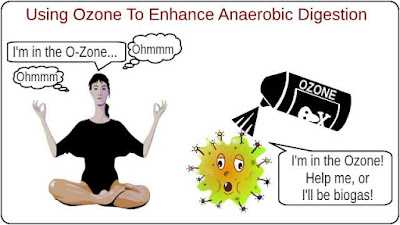
Fifth, Air products and Chemicals Inc. is patenting its methods for using ozone to enhance anaerobic digestion. It seems a reasonable bet that ozone can be used as a method to pre-treat digester feedstocks for quicker and more complete biogas production.
Finally, in our sixth item, a new US report is available on Global Anaerobic Digesters Market Demand, Trends, Opportunities and Forecast Report 2018.
Please comment below: Did you like the new format and the cartoons or not? Please tell us your opinion by commenting below.
1 - Anaerobic Digestion Gaining Popularity and Development Momentum
Converting waste into energy with the help of anaerobic digestion is a fast-growing trend spreading across industries and countries throughout the world.

As the technology improves and the process gains acceptance, announcements of new projects are becoming quite commonplace.
That’s great news for the environment, and the team at American Organic Energy is thrilled to be part of this innovative and important movement.

According to its estimates, these efforts “would reduce carbon emissions by an estimated 554 tons a year.”
It’s hard to top an announcement like this from one of the most prominent figures on Earth, but the Queen isn’t the only one throwing her hat—eh, crown—into the ring. via A D Gaining Popularity

As the technology improves and the process gains acceptance, announcements of new projects are becoming quite commonplace.
That’s great news for the environment, and the team at American Organic Energy is thrilled to be part of this innovative and important movement.
2 - An Anaerobic Digester Fit for a Queen?
It’s true. The Royal Family in London, England recently jumped on board the trend, too, announcing several energy efficient initiatives. In addition to installing solar panels and ground source heat pumps, Buckingham Palace is looking to construct an anaerobic digestion unit to generate fuel from its organic waste.
According to its estimates, these efforts “would reduce carbon emissions by an estimated 554 tons a year.”
It’s hard to top an announcement like this from one of the most prominent figures on Earth, but the Queen isn’t the only one throwing her hat—eh, crown—into the ring. via A D Gaining Popularity
3 - Tips on using anaerobic digestate as a fertiliser
Using anaerobic digestate to feed arable crops can save farmers up to £110/ha on bagged fertiliser costs. However, there are many rules on its application in the UK.Getting it wrong will not only bring the risk of being on the wrong side of the law, but it can also have adverse affects on soil and the environment, such as reduced earthworm numbers when applied at too high a rate.

Farmers Weekly gets some advice from an independent expert on how to reap the benefits, the right way... via TipsFarmersWeekly
4 - World’s first poultry litter anaerobic digester up and running
What is thought to be the world’s first anaerobic digestion (AD) plant using only poultry litter as feedstock is up and running in Northern Ireland.
Located at Tully near Ballymena, Stream BioEnergy and its partners received the go-ahead for the plant in June of 2016. The facility first went into production in 2017. via PoultrylitterAD

Located at Tully near Ballymena, Stream BioEnergy and its partners received the go-ahead for the plant in June of 2016. The facility first went into production in 2017. via PoultrylitterAD

5 - New Patent Air products and Chemicals Inc. - Methods For Using Ozone To Enhance Anaerobic Digestion
Ozone (O3) is a powerful disinfectant with many industrial and commercial applications. For example, ozone is used to oxidize organic contaminants from drinking water, including the naturally occurring taste- and odor-causing compounds. ...
It has been found that ozone may also be used to enhance anaerobic digestion by converting difficult to biodegrade compounds into more easily biodegradable compounds. Ozone may be used in this way to enhance biogas production from anaerobic digestion. For anaerobic digestion of sludge, it is theorized that the ozone lyses the cell membranes, thereby exposing the more easily biodegradable cytoplasm of the bacteria.
Fermentation waste, often called vinasse, can contain compounds such as phenols that are toxic to the anaerobic bacteria and other larger carbon-based compounds that are recalcitrant.
Pretreating this feed with ozone will reduce or eliminate the toxic compounds and make the larger compounds more biodegradable, thereby reducing the required residence time in the digester.
In an anaerobic digestion process, it is undesirable to have excess oxygen present because the oxygen reduces the methane (CH4) yield by promoting aerobic digestion.
Accordingly, there is a need for an improved method of recovering un-reacted oxygen from an ozone-generation process so that the effluent may be efficiently used for an anaerobic digestion process, while maintaining high efficiency in the ozone-generation system. via Ozone-FreePatentsOnline
It has been found that ozone may also be used to enhance anaerobic digestion by converting difficult to biodegrade compounds into more easily biodegradable compounds. Ozone may be used in this way to enhance biogas production from anaerobic digestion. For anaerobic digestion of sludge, it is theorized that the ozone lyses the cell membranes, thereby exposing the more easily biodegradable cytoplasm of the bacteria.

Fermentation waste, often called vinasse, can contain compounds such as phenols that are toxic to the anaerobic bacteria and other larger carbon-based compounds that are recalcitrant.
Pretreating this feed with ozone will reduce or eliminate the toxic compounds and make the larger compounds more biodegradable, thereby reducing the required residence time in the digester.
In an anaerobic digestion process, it is undesirable to have excess oxygen present because the oxygen reduces the methane (CH4) yield by promoting aerobic digestion.
Accordingly, there is a need for an improved method of recovering un-reacted oxygen from an ozone-generation process so that the effluent may be efficiently used for an anaerobic digestion process, while maintaining high efficiency in the ozone-generation system. via Ozone-FreePatentsOnline
6 - Global Anaerobic Digesters Market Demand, Trends, Opportunities and Forecast Report 2018
Albany, US, 2018-Mar-08 — An up-to-date research report has been disclosed by Market Research Hub highlighting the title “Global AD Market Report 2018” which provides an outlook of current market growth as well as the expected forecast including Rate on Investment (ROI) together with growing CAGR.

This report studies the Anaerobic Digesters market status and outlook of global and United States, from angles of players, regions, product types and end industries; this report analyzes the top players in global and United States market, and splits the Anaerobic Digesters market by product type and application/end industries. via GlobalAnaerobic Digesters Market Demand, Trends, Opportunities and Forecast Report 2018
Attribution: Buckingham Palace Picture. CC BY-SA 3.0, https://commons.wikimedia.org/w/index.php?curid=69391

This report studies the Anaerobic Digesters market status and outlook of global and United States, from angles of players, regions, product types and end industries; this report analyzes the top players in global and United States market, and splits the Anaerobic Digesters market by product type and application/end industries. via GlobalAnaerobic Digesters Market Demand, Trends, Opportunities and Forecast Report 2018
Attribution: Buckingham Palace Picture. CC BY-SA 3.0, https://commons.wikimedia.org/w/index.php?curid=69391


