In this article we have identified 6 popular anaerobic digestion and biogas plant products, which with the rising rate of biogas plant installation, has meant that these products are in high demand to ensure the proper running of an ever increasing number of anaerobic digestion plants.
(If you have suggestions for products that you think we should add, just add them to this page via our commenting facility below.)
1. pH/Redox measurement by Hach Lange
It is important to measure pH and Redox potential is all
anaerobic digestion plant fermenters, other than perhaps some of the most basic
un-mixed plastic membrane covered anaerobic digestion lagoons which are used in
hot countries, and are not optimized or controlled.
For all other plants this
measurement is essential, and also needs to be reliable, and very accurate even if not
re-calibrated over long periods. That's because the pH and redox information the device provides is used to
adjust the operation of the fermenter. Get that wrong and the production of biogas can cease!
Keeping a biogas plant running at close to its full design gas yield, is done mostly through adjusting
the feed material type and quantity day by day, and also at times, to decide on
how much of any dosing chemicals must be supplied to bring the pH or Redox back
within the optimum operating range. These adjustments are used to ensure that
the micro-organisms in the digester are maintained in the chemical conditions
in which they will thrive and produce the most biogas, at a high methane
quality.
One company that has a pH/Redox monitoring instrument which
is in high demand, and is designed for the extreme conditions found in biogas
plant reactors is Hach Lange.
It is best to provide their technical details to describe
this pH robe system. They state the following in their downloadable pdf file:
“The digital pHD electrode used to measure pH and redox is
fully encapsulated so that it does not come into contact with the fluid being
measured. A special, soil resistant salt bridge forms the direct contact to the
fluid to enable the measurements to be made."
"In contrast to conventional membrane based electrodes,
this electrode can be used for very long periods even in fluids with a high
particulate content, e.g. digester water. The intervals between cleaning are
especially long. Electrode poisoning, e.g. by any H2S that may be present, is
prevented and dilution of the electrolytes is avoided.”
There is more information about this popular product at:
2. pH Test Strips
pH test strips have been around for many years, but nowadays
the technology behind the best of these strips enables the user to assess the
pH value, and not just whether the liquid tested is acid or alkaline. They are
still not as accurate as using a good quality pH probe, however, they can be
very useful when an immediate assessment of approximate pH value is needed, and
when there is no probe, such as the Hach Lange pH/Redox probe discussed in 1.,
above.
For that reason we have included pH Test Strips in this list
of our "in demand" anaerobic digestion products.
Probably the best known test strips are those made by Merck
in their Millipore range. They offer a large number of products for pH
measurements with various methods of operation. These include pH indicator
papers, and MColorpHast™ pH test strips, and pH indicator solution, however it
is the simple test strips that are most used and can be an essential tool,
especially when carrying out process troubleshooting site checks on anaerobic digestion
plants.
For anyone that wishes to find out more about pH test strips
by Merck we suggest the following link as a starting point:
3. NPL Biogas
Analysis
NPL, once the UK's National Physical Laboratory is a private
company which specialises in carrying out trace-level impurity analyses for
gases, especially for biogas. Knowing what may be present in biogas as
trace-level impurities is critical for the design of the gas-engine for power
generation, and also increasingly for upgrading biogas to biomethane by
removing these impurities.
The concentrations of both the trace-level impurities which
cause corrosion and those that cause the build-up of hard silica materials on
valves, and combustion cylinders, are assessed by using these tests. Also, very
sticky tar-like substances within a gas-engine used for electrical power
generation, can build-up, and trace-level gas impurity tests will when used skilfully
by an expert, allow the need for pre-treatment of the biogas before it enters
gas engines to be investigated, thus avoiding the risk of very expensive
remedial maintenance on the power generation and biomethane upgrading system
later.
Traceable gas standards containing each of the following
components are available, from NPL as follows:
• Siloxanes (multi-component mixtures of the siloxanes most
commonly found in biogas)
• Hydrogen sulphide
• Ammonia.
Further information on this in-demand service can be
obtained from:
4. Prosonic Flow B 200 Ultrasonic Flowmeter
Almost all anaerobic digestion systems require the
monitoring of flow, and it is particularly important to measure the flow and
volume of the substrate feed continuously and accurately, so that the calorific
value feed that is added is known, and can be controlled. The Prosonic Flow B
200 by Endress and Hauser Ltd is a well-known example of such a flowmeter.
An inexperienced biogas plant designer might think that a
cheaper, vane type flowmeter would be satisfactory, but due to the presence of
fibrous materials in the flow, these get caught around the vane of a cheap flowmeter
and cause malfunction of the device. As a "non-intrusive" flowmeter
the ultrasonic types are very well suited to biogas applications, and ATEX
rated explosion proof versions are also available to avoid explosion risks
where these occur.
Further details are available at:
5. Biogas Plant Mixer Systems
Biogas plant mixing systems have traditionally been
under-specified for completely stirred mixed reactor type biogas plants. With inadequate
stirring, their performance can be far below what would be achieved if well designed,
good quality mixing, was installed and operated.
Anaerobic digestion operators can experience problems with
the build-up of a hard cap of biomass floating on the surface. It can impede
the circulation of biogas through this "hard crust", and as the crust
can contain a large proportion of the organic material in the reactor, the rate
of biogas production can be significantly reduced.
The installed mixers may be incapable of breaking up the
"hard crust" and opening the top of a reactor to physically smash up
a floating crust, means significant plant down-time, and loss of biogas
production.
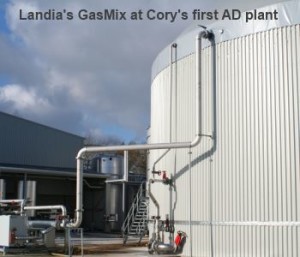
The Landia GasMix has not been around for even 18 months
(time of writing is May 2015), and yet it is a biogas plant reactor mixing
system that is in high-demand. Users report that once installed, and using the
cleverly designed combination of biogas and substrate purging, hard crust
accumulations can be broken up and re-submerged in not much more than half an
hour of operation using this system. Once initial crust break-up and
re-suspension has been achieved, the system is run on an automatic setting and
runs for only short periods daily, to prevent any further significant build-up
of floating material.
Further information of the Landia GasMix is available here:
6. Biogas Storage Covers and Vessels
If there is one thing that all biogas plants have in common
is that they produce gas which must be stored, until needed. Suppliers of
biogas storage covers and vessels, have been in increasing demand for their
products, as the rate of anaerobic digestion plant construction has
accelerated.
VERGAS Ltd is a leading company in biogas storage systems,
and specialises in the design, manufacture and installation of high quality
flexible membrane biogas management equipment, worldwide.
The following is a link to VERGAS Ltd's website where
further information on biogas storage covers and vessels is available:
Conclusion
We hope that this article has been useful. If it has, or
even if it has not and you have suggestions on improvement you would like us to
make, please provide us with feedback via the "commenting" facility
below, or via our contact page.