Sunday, March 13, 2016

Round Up of Biomethane Projects in North America

The number North American biomethane projects in 2016, is growing! In this posting we take look at the development of biomethane upgrading plants which purify the methane output from anaerobic digestion plants, making it a high value, quality controlled, fuel, potential to provide an enormous greenhouse gas emissions reduction. 

A "plain vanilla flavor" biogas plant, becomes a "biomethane" plant as soon as the upgrading equipment is commissioned.


Europe has been upgrading biogas plants and building new ones, which will "upgrade" their biogas from the start, quite rapidly. In fact, a transition is beginning to take place from the on-site use of biogas energy in gas-engines for supply electricity into the local grid, to the upgrading of biogas for off-site uses, including as a transport fuel for the road haulage industry and also for general gas grid supply.

One reason for that is the reduction in favorable Feed-in-Tariffs, which have offered government subsidies in some nations, but it also raises the efficiency of the use of the methane gas energy, and in turn therefore also raises the sustainability of anaerobic digestion energy (biogas) systems.

Until recently there was less interest in this technology, in the US and Canada than in Europe. However, since the start of this year (2016), the outlook (as highlighted in the following articles). looks more promising.

Our first article below is about developments in the biomethane produced by Clean Energy Fuels Corp., which by their estimation could yield a whopping 90% reduction in carbon emissions when displacing diesel or gasoline.

Our second article is about the fact that construction has begun on a Canadian (British Columbia) biomethane project which will provide renewable natural gas to fuel the city’s waste-collection trucks. An added benefit here will be that the emissions from natural gas fueled refuse collection vehicles is much lower than that of diesel fueled vehicles. These trucks that spend all their working lives in congested streets and urban highways will now make the air healthier for residents as well.

Our third article and final article below is included to show that the market is ready to buy the low carbon emission fuel from biomethane plants, in Canada. In fact, there is strong pressure from energy utility companies to offer sustainable green energy to their customers.
That means that investors who are thinking of dipping their toes into a new "green energy market" could do well to look at biogas plant and especially biomethane upgrade investments.

Clean Energy to be First Commercial Distributor of Biomethane Fuel in California

Clean Energy Fuels Corp. announced it will be the first company to commercially distribute its signature biomethane fuel “Redeem” across 35 stations in California.

“It’s a landmark day for Clean Energy as the first company to make this revolutionary and renewable transportation fuel made from waste available to our customers,” 

said Andrew Littlefair, president and CEO of Clean Energy. He added the company’s goal is to produce and distribute 15 million gallons of its Redeem fuel in its first year, assist California meet its climate change goals and prove the fuel is a viable alternative fuel source.

Clean Energy hopes to keep its California retail infrastructure flowing with Redeem as the state’s fuel infrastructure grows, said Harrison Clay, president of Clean Energy’s renewable fuels division. He added Clean Energy will focus on California’s initial market, which is economically beneficial to the biofuel, before rolling out its signature biogas into other states.  

“I don’t know if we have a state that’s the next big target,” said Clay. “We’ll go where the demand for natural gas fuel is the highest. I know we opened our LNG truck stop stations in Texas, so that might be a good market for us.”

The biomethane is produced from extracting methane gas from Clean Energy’s landfills and other waste streams, cleaned and processed by a production facility and deposited into the interstate natural gas pipeline. It is available as compressed or liquefied natural gas forms.

California Air Resource Board estimated the biomethane could yield a 90 percent reduction in carbon emissions when displacing diesel or gasoline. “Clean Energy’s new Redeem product will help cut greenhouse gas emissions on our roads while providing customers a lower-priced fuel when compared to gasoline or diesel,” said Mary Nichols, board chairman of California Air Resource Board.

Clay said the future of biogas usage is very promising:

“We’re offering a one-of-a-kind, lowest cost and best breed of alternative fuel. We can offer fuel to our customers that can meet 100 percent of the fuel requirements of an 18-wheeler without a sacrifice in performance that can be offered and sold to them cheaper than petroleum fuel products,” 

he said.  via Clean Energy first commercial distributor of biomethane fuel

Construction Underway on British Columbia Biomethane Project

Earlier this year, Orgaworld Surrey Ltd. began construction on a biofuels processing facility to convert kitchen and yard waste from the city of Surrey, British Columbia, into renewable natural gas to fuel the city’s waste-collection trucks.

“They have done site preparation and they are now working on the foundations and will start pouring the floors of the facility,” said Paul Oostelbos, director of international business development.

The biofuel facility is being developed as a public-private partnership (P3). Orgaworld Canada Ltd., an organic waste processing business part of Shanks Group plc, contracted with the city of Surrey to develop the project. Now, its subsidiary Orgaworld Surrey Ltd. will head up the project, undertaking the design, build, finance, maintenance and operation of the facility. Multiple partners are involved with the development of the project including Stantec Architecture Ltd. to work on the design-build and services contract and the local construction company Smith Bros. & Wilson Ltd. to prepare the site, procure the equipment and materials, construct infrastructure and building components and install the equipment desired.

This project is considered one of P3 Canada’s flagship projects. The Canadian government approved Surrey’s application to the P3 Canada Fund, awarding the project a contribution up to 25 percent, or a maximum of $16.9 million, of the capital cost of the future biofuel facility. In total, the project is expected to cost 65 million in Canadian dollars ($45.9 million).

The facility is being constructed on city-owned property located in Port Kells adjacent to the Surrey transfer station in a grass building area about 14,323 square meters. The city collects waste from approximately 100,000 households, and based on recent studies, approximately 65 percent of its residential garbage is composed of organic waste that could be diverted to the Surrey biofuels processing facility. The facility will have the capacity of processing upward of 115,000 metric tons of organic waste per year. A majority of the feedstock—80,000 metric tons per year—will come from Surrey’s residential curbside collection program, and some commercial organic waste will also be processed, supporting the Metro Vancouver Food Scraps Recycling Program.

The plant is being implemented as the second phase of the Surrey’s Rethink Waste Program. “The city of Surrey wanted to close the loop,” Oostelbos said.

“They want to convert their source-separated organics into biogas that would be used to fuel their waste collection trucks and their city fleet.”

According to Oostelbos, the city has a local objective to divert more than 70 percent of waste from the landfill through alternative reuse, increased recycling and material recovery programs.

 “By closing the approach we will convert their source-separated organics—the kitchen waste, garden waste—into mainly two products,” 

Oostelbos said.

“One is the biogas, which will be upgraded into natural gas quality. The second product is compost, which can be used as an organic fertilizer for agricultural reasons and various applications within the city.”

More than 20 waste trucks will be fueled with compressed natural gas (CNG) at peak site capacity. Upon arrival in the CNG-fueled trucks at the west entrance of the building, the waste is then stored, shredded, processed to produce gas, composted, screened and shipped out from the north exit. Shredding equipment will be located in the facility’s entry, with loaders transporting the waste within the facility, the storage bays, reactors, composting tunnels and the compost storage bays. Within the screening halls, equipment will sort the compost and move it via overhead conveyors into the composting storage areas. The facility will produce approximately 35,000 metric tons of compost per year.

The anaerobic digester (AD) technology being implemented is Orgaworld’s Biocel, dry AD equipment, already implemented by the company in the Netherlands. Oostelbos said the process requires very little pretreatment.

The gas-upgrading equipment provider for the project is still under negotiation.

“What we see in North America is that more and more cities are changing to CNG-fueled trucks, and that they also have to look at the amount of food and kitchen waste going to the landfill,” 

Oostelbos said.

“I think there is a great opportunity for these types of projects in North America.”

Besides the biofuel processing area, the facility will have an administrative area to provide visitor facilities for public education on biofuel production. The third level of the administrative area will include a conference room, visitor gallery and a roof garden for educational purposes.

The projects anticipated service commencement is in early 2017. “It’s the first and largest of its kind,” Oostelbos said.

“The combination of dry AD with composting allows us to produce quality products. We also have 2 or 3 percent of material like plastics that we will convert into alternative fuel for the local cement industry. We tried to avoid as much landfilling as possible.”

The project has also been nominated for a number of awards including the National Award for Innovation and Excellence in Public-Private Partnership in the category of project financing of the Canadian Council for Public-Private Partnerships. It has also been shortlisted for the 2015 P3 Awards for the category Best Waste/Energy/Water Project, [for] which they will receive notification about Oct 8. via Construction underway on British Columbia biomethane project

British Columbia Utility Fortis Seeks Additional Biomethane for Energy

British Columbia utility FortisBC is seeking additional biomethane suppliers for its renewable natural gas program.

The subsidiary of St. John’s, Newfoundland-based Fortis Inc. said in a news release it is seeking an additional supply of up to one petajoule, or enough natural gas to provide heat and hot water for about 10,000 homes annually.

The company is seeking submissions from landfills, wastewater treatment plants, farms and agricultural businesses, and other biogas producers.

"Demand from our renewable natural gas customers has resulted in the need for further biogas supply in our system," 

said Doug Stout, vice president of energy solutions and external relations.

"Our focus is to help put waste to good use by working with suppliers to develop this energy source for our customers."

Two projects currently supply biomethane to FortisBC, with five others under development or construction. via British Columbia Utility Fortis Seeks Additional Biomethane for Energy

Saturday, January 23, 2016

Quadruple Growth Predicted in Biomethane and BtG In the UK and Europewide

The idea that the number of biomethane plants could quadruple by 2021 sounds remarkably optimistic, but it is a figure supported by the top industry experts. 

It is a prediction which will be very welcome news for all those that have for so long worked in the industry and striven to convey to anyone who would listen, the many advantages of the anaerobic digestion process.

Biomethane is the term used for the raw (anaerobic digestion plant) biogas which is purified into "biomethane" before being sold, and the use of that "green gas" for injection into the gas supply grid is one of the very most efficient uses of that energy. 

Until recently, the most common use of biogas was to use it after only a minimum purification (to avoid corrosion of the generator equipment) to create electricity. However, producing electrical power invokes a large loss of that energy in the electrical distribution system, and a much higher loss than in the natural gas grid (although energy is of course expended in the purification (upgrading) process). 

It is also wonderful news for the environment, and will significantly reduce greenhouse gas emissions if this number of plants is built. Additionally, other biogas plants will continue to be built for electricity production, and will continue to expand the overall renewable energy output in electricity.

This is, not forgetting that, biomethane is also very useful as a transport vehicle fuel (Bio-CNG), as explained in our final article excerpt.

So, now! If you want to check the validity of what I am saying here, read on!

ADBA (UK) concludes that the number of biomethane plants could quadruple by 2021

Dec 16, 2015: According to the latest data, Europe counts with 17,240 biogas and 367 biomethane plants. For the past six months, the EBA team has joined efforts to compile its Biomethane and Biogas Report 2015, the annual statistical report on the European anaerobic digestion industry and markets. via european-biogas.eu

EBA Biogas Report will be shortly available!

According to the latest data, Europe counts with 17,240 biogas and 367 biomethane plants. For the past six months, the EBA team has joined efforts to compile its Biomethane and Biogas Report 2015, the annual statistical report on the European anaerobic digestion industry and markets.
via Green Gas Industry Could “Quadruple” With New RHI Budget

...The Anaerobic Digestion and Bioresources Association (ADBA) forecasts that the Chancellor George Osborne’s spending review could support the construction of an additional 140 biomethane plants. The announced £1.15 billion allocation for the Renewable Heat Incentive (RHI) budget by 2021 could quadruple the number of UK biomethane plants. These plants represent a fourfold increase on current numbers […]
The post UK: ADBA concludes that the number of biomethane plants could quadruple by 2021 appeared first on European Biogas Association.

via UK: ADBA report concludes that the number of biomethane plants could quadruple by 2021

The UK has seen a further 23 biomethane to grid (“BtG”) connections in 2015. This makes a total of 50 BtG sites and means that, for the second year running, the UK has been the fastest growing biomethane market in the world.


Judging from the above, we do seem to have been correct when last year we reported in this blog How the Big Picture for Anaerobic Digestion and Biogas Gets Yet Bigger!

UK sees highest level of Biomethane to Grid (BtG) growth in the world

BtG is the process whereby renewable gas is injected into the UK’s gas grid, giving the UK a highly flexible and efficient source of green, sustainable energy made from organic material include food waste.
John Baldwin, CNG Services founder and managing director said:
“The growth experienced in 2014 has continued with a total of 47 new projects in the last two years, the highest level of growth of any gas market in the world”
“Biomethane is a highly flexible renewable fuel as it utilises the extensive and valuable UK gas grid to provide energy both for gas central heating and also to fuel supermarket distribution trucks” ...
Baldwin continues:
“Growth of BtG has been spectacular. ... Growth accelerated markedly in 2014 with CNG Services connecting over 20 plants across the UK working with customers including Wyke Farms, Severn Trent, Wessex Water, Refood and Future Biogas.
Baldwin comments:
“When you look at how fast this industry sector is developing, it’s clear that BtG is going to be the biggest renewable heat technology in the UK. I’m proud of the part we’ve had to play in this success story”.
Biomethane has had the support of the [UK government subsidy known as the] Renewable Heat Incentive (RHI) worth £860 million. ...
Biomethane is also increasingly being used as a fuel for transport, known as Bio-CNG, where is offers big environmental benefits.
For the full article, visit : http://www.cngservices.co.uk

We would be delighted to see your comments below. Do you agree that this predicted rate of growth in AD plants for biomethane production is realistic, for example? Are you worried that energy crops will raise the cost of food, by doing this? Is this the right way forward for renewable energy production, or are there better ways of using organic waste materials? Please give us your opinions here.

Tuesday, January 12, 2016

UK AD Plant Installation Contractors Rush To Complete Biogas Installations Ahead Of FiT Reductions


A new set of UK Feed-in-Tariff (FIT) reductions known as "degressions" will come into force from 31 March 2016. This has led to companies rushing to complete existing projects and starting new ones early, to ensure that their anaerobic digestion (AD) projects get the last of the high subsidy rates.

Rates will only drop 5% to 11% at the start of April, but there is widespread concern that the mechanism known as degression, which it is hoped will soften the run-down of this subsidy, will deter the commencement of a large number of projects due to start later this year, and result in a high level of UK AD Plant Installation Contractor bankruptcies.

The idea of degression is that as the target spending level approaches, the FiT will be reduced more rapidly. This should minimize government overspending if the uptake of the FiT is rapid, but the uncertainty it introduces into predictions of anaerobic digestion plant project profitability could simply stifle demand for new biogas plants. If that happened it would set-back the UK's biogas industry for years, and cause widespread job losses.

How The UK Got UK AD Plant Installation Contractors Into This Situation

This has been explained by CooperOstlund's Johan Ostlund in the January 2016 edition of Wet News, as follows:

"Feed-in Tariffs (FITs) were introduced by the government in 2010 to help increase the level of renewable energy generated in the UK. The subsidy outlined that renewable generation systems, up to a capacity of five megawatts (MW), were eligible for financial support for producing green energy.
Alongside helping the UK towards its legally binding EU target of 15% of total energy from renewables by 2020, the incentives aimed to drive long-term investment in renewable technology and innovation.
Since its introduction, the scheme has been hugely successful. In 2014 alone, the anaerobic digestion (AD) industry installed 89 new plants in the UK, a high percentage on site at water companies, food manufacturers or recycling businesses to turn organic waste, wastewater or sewage into renewable energy.

Energy targets

In fact, such has been the success of the financial support for AD installations that the industry now exceeds 500MW of total capacity across 411 plants nationally, making a significant contribution to the UK's renewable energy targets.
FITs have transformed the way the UK generates its power over the past three years, with more than 22% coming from renewables in the early part of 2015.
However, this has come at a price and the Department of Energy and Climate Change (DECC) admits spending on clean energy support is projected to be as much as £1.5bn over budget by 2020/2021.
In a bid to keep the budget under tighter control, the government introduced the FITs degression mechanism, which automatically reduces the level of subsidy available to new projects once a certain level of deployment is reached. Now, as part of the latest review, DECC wants to cut expenditure on the FITs scheme to between £75M and £100M, from January 2016 to 2018/19 and has significantly reduced the rates it will pay.
As part of these latest FITs degressions, financial support for AD sites will decrease significantly from the end of March 2016. In fact, the tariff for facilities under 500KW will reduce from 10.54 to 936p/Kwh, while facilities greater than 500KW will drop from 9.16 to 8.68p/Kwh." via WWT Online-WetNews

Opinion

It would be foolish of any government to continue to damage the UK'S renewable energy industry/UK AD Plant Installation Contractors in the way it has the solar panel and home insulation industries over the last 6 months, since the current Conservative Government got into power in May 2015.

For a party which is says it is both keen to introduce measures which will reduce climate change, and provide employment/support businesses, while improving the UK's housing stock, it is hard to fathom why they would jeopardize the biogas industry in this way, with all its beneficial spin-off's.

Please give us your comments below (Click on "comments" to add your own.)

Tuesday, December 29, 2015

5 Awesome Advantages of Using Biogas as a Cooking Fuel

The biogas from a home biogas plant need only be compressed by placing a weight on the biogas collection and storage sack or dome over the digester tank, and possibly filtered through water, before it can be piped directly into a cooking stove,

This is truly cheap and simple to do, and the initial "fuel" or feedstock that the biogas digester is made from is simply the waste organic material produced by the family or community which runs the digester.

In rural communities in the developing nations, the following list of advantages normally will apply:

1. Biogas production needs less labour than tree felling, especially when the trees are far away from the home and need to be transported.

2. Trees can be retained. Using biogas avoids the need for constantly removing trees for firewood allowing forests and woods to recover and grow, bringing shade, shelter, and forest products, plus maybe food as well.

3. Biogas is a quick, easily controlled fuel. Turn it on at a tap, light it and the heat is there to use immediately. In contrast, using wood takes time to get the fire warm enough, and the fire needs attending for that period as well.

4. Biogas emits no smoke when burnt correctly. It has no smell when pure (unless there is a leak and then you need to know of the leak, in any event). This means massively reduced eye and respiratory irritation, and extends the lives of all who use smoky wood stoves.

5. Clean pots! Yes. Pots and dishes, in fact, everything remains much cleaner when using biogas as a cooking fuel instead of wood.

In reality, these are just a few of the examples were using biogas for cooking instead of wood, or even fossil fuel alternatives such as LPG in cylinders, (which is so expensive in the developing nations), has so many advantages.

So, why aren't more people doing it? Let us read your opinions please, in the comments box below.

Sunday, December 06, 2015

Anaerobic Digestion Creates Heat but is UK Industry Overheating?

The anaerobic digestion process creates heat, and this is especially useful when it is used on the site of the digestion plant or is piped of-site to heat homes, and be used in industries near to the AD Plant. But, in another, largely political sense has it been overheating? Has there been such a large increase in the number of AD facilities in the UK that the government has decided that like the wind power and solar industries, whatever their industry experts say the industry no longer needs government subsidies to continue to grow?

In this article we will provide information on both the "heat" and the "overheating" of the UK biogas industry. First we will look at a case study where heat exchangers have been used, as part of a renewable heat system:

HRS heat exchangers creates anaerobic digestion plant for Muntons

heat exchanger in anaerobic digestion

The food sector has invested heavily in bioenergy projects such as biomass boilers and anaerobic digestion but where heat which is generated or used in one part of a process is lost rather than reused, according to HRS.

Image by cizauskas via Flickr
One of the most common situations where heat is wasted is where businesses have installed an AD plant to manage their food waste and factory by-products, said Matt Hale, international sales manager, HRS Heat Exchangers.

Heineken, Weetabix, Maltesers & Ovaltine

“In most cases the primary energy output is electricity supported by Feed-in-Tariffs (FITs) which is used on site or exported to the grid,” he added.
“The electricity is generated by a gas engine combined heat and power plant, but what happens to the heat? In some cases it is used for processing or heating the food factory, but often not to its full potential.
“Implementing HRS heat exchanger technology, to use waste heat from one process to fuel another, could save food factories 7.5 pence per kWh² used.”
One such company is Muntons malted ingredients based in Suffolk, UK which supplies malt to Heineken beer, Weetabix, Maltesers and Ovaltine.
The firm uses 250,000 tonnes of barley to manufacture 180,000 tonnes of malt pa, which it sells the brewing and distilling industry and makes a range of malted ingredients used in food, confectionery and baking.
The company is currently putting the finishing touches to its £5.4m on-site anaerobic digestion (AD) plant. Integral to the success of the 499 kW facility is a 3 Tank Batch Sludge Pasteuriser System with Energy Recovery from HRS Heat Exchangers, which will help turn 80,000 tonnes of Muntons’ liquid malt waste into biogas and organic fertiliser.
This biofertiliser will be then be applied to local farmland, helping the company’s network of growers to produce the barley needed to make Muntons’ malt.
“For Muntons, this whole project has been about maximising efficiency. Although they have an abundance of heat, they still wanted to recapture what they could and our heat exchangers will provide at least 40% heat regeneration,” said Hale.

AD is a fast-growing industry in the UK 

He added AD is a fast-growing industry in the UK and has seen a steep rise in operational plants: from 192 in 2009 to 335 in January 2015. AD could deliver 10% of Britain’s domestic gas demands and reduce UK greenhouse gas emissions by 2%+ if industry reaches its potential: 40TWh of energy.Via HRS heat exchangers creates anaerobic digestion plant for Muntons

Gaunts Estate Anaerobic Digestion District Heating

Gaunts Estate near Wimborne, Dorset is the site of three new district heating schemes, powered by three separate anaerobic digestion plants.

Throughout the schemes, 1600m of REHAU’s flexible, pre-insulated RAUVITHERM pipework is being installed to connect the AD plants to the various farms, dwellings and countryside buildings on the estate.

The huge jump upward in the quantity of United Kingdom gas which was supplied by biogas from anaerobic digestion (AD) and landfill gas last year, has been lept upon by the UK government as evidence that there is a similar overheating of the biogas industry in the UK to that seen in solar power farms, and wind turbines, and seems to have given them an excuse to reduce subsidies. 

The degree to which the industry has been "heating up" (in other words over-achieving government targets) making Conservative politicians confident that they can save UK taxpayers money, and still achieve EU climate change targets, is shown in the paragraphs below.

Parliamentary report shows green gas heating up

In 2014, the UK produced 37 billion cubic metres (bcm) of natural gas and biogas combined; 2.6bcm of which was generated from AD and landfill. Since then the biomethane industry has quadrupled in scale, with 40 gas-to-grid plants now generating enough indigenous gas to heat over 100,000 homes or fuel around ten per cent of the UK’s bus fleet. POST estimate that UK natural gas production will fall from 2016, with biogas becoming an increasingly important part of our gas supplies. 
The POST report’s release comes a week before the Spending Review, which will set out the government’s plans for future support for biomethane, and follows a recently leaked letter from the Energy Secretary, Amber Rudd, to her Cabinet colleagues that appears to signal recognition for biomethane’s role in a sustainable UK energy mix.  
 ADBA’s Chief Executive, Charlotte Morton, commented:

The fact that green gas represented 7% of the UK’s indigenous gas supply in 2014 represents a colossal milestone for the biogas industry. And the timing could not be better as the Chancellor considers the future of the Renewable Heat Incentive, which is crucial to facilitate further growth in biomethane, in his Spending Review announcement next week.
With continued support for additional biomethane capacity, anaerobic digestion could potentially meet 30% of UK domestic gas demand.
The UK needs 20TWh more renewable heat by 2020 to meet the government’s 12% target – biomethane could deliver a third of that. via Parliamentary report shows green gas heating up | News | ADBA | Anaerobic Digestion & Bioresources Association
Has the UK government cut the biogas subsidies so hard that they kill off the young UK anaerobic digestion plant industry, and ruin the UK's, so far, good record of compliance with climate change targets? They seem not to care about removing the heat, but will the industry go too far off-the-boil?

We will report on the effects of recent UK government announcements on biogas plant subsidy reductions again in a further posting to this blog soon.

Saturday, November 28, 2015

The Latest Development in Home Sized Anaerobic Digestion Plant Units

It was only a matter of time before someone hit upon the idea of crowdfunding to finance the development of an anaerobic digestion plant designed for western/ developed nation use.

As a long-standing anaerobic digestion and biogas blogger I am often asked in the emails I receive, where the enquirer can buy a home biogas unit. If the request is for a single household sized unit, until now there has not been a system which I considered was available in the US, UK or Europe, with full support from a reputable supplier/ installer at any price.

I have been advertising a "home made biogas unit" on my blogs, for a while now, and although there have been a few DIY blueprints available to buy and download online, I have found that the number of individuals in the wealthy nations who wish to make a biogas plant themselves, are very few and far between.

Now all that appears to be changing. It seems that there is a pre-built package unit, as described below, that presumably comes delivered and ready to switch on and fill with organic household waste, the market for such a biogas unit may be much larger. It will be interesting to see if that is the case.

Watch the video below:


Call me a skeptic if you like, but I do still doubt that many will buy this, even if the 2-4 hours of cooking time daily proved to be correct,. However, the cooking time stated is well above the biogas generation rate usually attributed to such systems.


In addition, in the "wealthy west" not many people will want to mess around with their food waste, let alone spend time mixing pet litter with water in order to put it into the digester.


There may be a market for this product nevertheless in colleges, and universities, plus maybe even schools, where students can be given projects to demonstrate how biogas can be made.


But, until proved to me otherwise I don't think there will be many household takers even at the current reduced current price, but I would be delighted to hear from readers in feedback (use the comment box below) that I am wrong.

Home sized biogas unit lets you convert your own organic waste into cooking fuel

It’s never been easier to generate your own power. Israeli startup Home Biogas has developed a relatively affordable home-sized biogas unit that allows people to convert their own waste into fuel. The compact unit, which is currently running a crowdfunding campaign to support its production costs, lets everyday homeowners convert their organic waste into enough gas for 2-4 hours of cooking and 5 to 8 liters of liquid fertilizer per day.
© HomeBiogas
 The HomeBiogas unit is a perfect match for homeowners who would like to start a full-cycle waste recovery system in the comfort of their own home. The unit has the ability to take in up to 6 liters per day of any food waste or up to 15 liters per day of animal manure and turn it into fuel for cooking as well as organic fertilizer.
© HomeBiogas
HomeBiogas is being marketed to the average homeowner, either already off-grid or just looking into a “homemade” renewable energy source. According to the system details, the unit can convert just one kilogram of food waste into about 200 liters (7 cubic feet) of gas, more than enough to fuel an hour’s worth of cooking.
In addition to its reasonable cost and exceptional environmental value, the sleek rectangular unit is quite easy to use and easy-to-assemble. In fact, it measures in at 48”x65”x39.4” and weighs less than 88 pounds.
If you’re interested in buying the HomeBiogas unit, the company is offering supporters an opportunity on their crowdfunding page to reserve one with a pledge of $890. Once the campaign is over, the unit will go back to its regular retail price of $1500.
via Home sized biogas unit lets you convert your own organic waste into cooking fuel
Mean while Treehugger has a slightly different view on this:

Home-sized biogas unit turns organic waste into cooking fuel and fertilizer, for under $900 : TreeHugger

A startup from Israel has developed a home-sized biogas unit that can take organic waste and convert it into enough gas for 2-4 hours of cooking, as well as 5 to 8 liters of organic liquid fertilizer, every single day.
The accurately-named HomeBiogas device could herald a new dawn for full-circle local waste recovery for both on- and off-grid homes, because it has the ability to take in up to 6 liters per day of any food waste (including both meat and dairy, which are often not recommended for home composting) or up to 15 liters per day of animal manure (including pet waste, which is also considered a no-no in home composting), and turn that into enough fuel to cook several meals per day, while also producing a rich organic fertilizer that can boost soil fertility and garden yields.
While many home biogas initiatives tend to be focused on the developing world, where animal and human waste can be converted into a clean-burning fuel for cooking or heating water, providing a renewable local energy source, this project is aimed at the suburban market, where it can function as a valuable component of a home's energy network, either as an adjunct to grid-based systems or as an off-grid accessory.
According to HomeBiogas, 1 kilogram of food waste can produce an average of about 200 liters (7 cubic feet) of gas, which can fuel an hour's worth of cooking over a high flame, so with a full daily input of 6 liters of organic waste, the company's units can produce several hours of cooking gas each day, and can help homes eliminate one ton of organic waste each year, and avoid generating the equivalent of 6 tons of CO2 annually. Via Home-sized biogas unit turns organic waste into cooking fuel and fertilizer, for under $900
To wtach this on YouTube click here.

Summary

So, here you have it. Is this really going to be the first true Home Biogas Plant for the developed world, turning waste into gas and fertilizer?

Food waste and declining energy sources are major environmental hazards.
Biogas is the solution it's a natural process in which organic waste is converted into cooking gas so five years ago we went on a mission to bring biogas to every home regroup the best engineers scientists designers and product people togethere Markiting manager of HomeBiogas Ron Yariv Said:
Homebiogas is the first family sized user friendly affordable biogas system.
It is the [latest biogas digester design] and you can put it in your backyard. This home biogas plant comes in and easy to assemble kit and it uses a simple-as-can-be [system] just [by] throwing your organic waste in there. You go [and get your]  hot stove ready for cooking. [It produces] a cycle of in-house energy and it runs with no electricity or leftovers, [but also it] provides you [with a claimed] two to three hours of energy and [you fill it with]... handy kitchen leftovers, including meat and dairy products.... even your pet's litter. via Home Biogas Plant -Turning waste into gas and Fertilizer - Do Science!

Let's have your opinion. Is this worth buying?

Saturday, November 14, 2015

Anaerobic Digestion Companies Grow From Hundreds to Over a Thousand in Just 10 Short Years

Anaerobic digestion companies are a major growth sector within the global marketplace. Until 10 years ago there were probably no more than 100 companies in the developed nations which were actively trading as anaerobic digestion companies, or perhaps would also have been known as biogas companies, and now there are likely to be over a thousand.


Anaerobic Digestion (AD) is a natural process which will never be patented, it is as old as life on earth. The process was one of the very first to evolve on earth, we know that because AD was taking place before there was oxygen in the earth's atmosphere. AD is simply the umbrella term for any reaction where plant and animal materials (known as biomass) are broken down by micro-organisms without there being any air present. In fact anaerobic digestion only takes place when air is not available, at least not enough is present for aerobic degradation, and it makes methane gas as an inevitable consequence of the sequence of complex biochemical reactions it entails.

The process being more than a short time "out of patent" (millions of years!?), leads to the possibility that anyone can design and build AD Plants using this process, and many companies have been created to do just that!

Main Types of Anaerobic Digestion Companies

There are now a number of different types of anaerobic digestion companies. There are anaerobic digestion specialist companies which will design, build, and construct a complete AD Plant (DBC Contractors). Some of those contractors will go further than that even and will maintain and operate their AD Plants as well as DBOOT Contractors (Design, Build, Own, Operate, Transfer).

There are also specialist contractors, calling themselves AD Companies, which design and build just part of a biogas plant, such as the heat exchangers, and/or CHP equipment

Within the sector of Design and Build Contractors in the developed nations  these companies are usually, as a general rule, specialist companies in one, or at most two, of the following anaerobic digestion plant client sectors:

a) Sewage sludge treatment and biogas production
b) Agricultural sector biogas plants
c) Waste Management Sector anaerobic digestion plants for processing the organic content of residual (also known as "black bag") household domestic waste, and food waste biogas plants.

Some of these companies specialise in one of the commonly optimised temperature ranges of biogas reactors, this being in either mesophilic or thermophilic biogas plants, and others offer two stage AD Plant variants in pursuit of improved reliability, efficiency and better profitability.

In all these sectors you will now also find both companies (i) which apply the normal accepted design criteria to their plants, and, (ii) innovation companies that offer what are presented as "high-tech" versions of the standard biogas plant, which claim, and in many cases no-doubt do achieve, higher gas yields and lower sacrificial energy burdened plants.

The normal accepted "standard" design for biogas plants is the process which is known as a completely mixed reactor process AD Plant. This is the most "tried and tested" type. These comprise 90%, or more, of the anaerobic digestion plants which can be seen dotted about the landscape. They are easily spotted for their large circular based reactor tanks, over which there is is a plastic material covered dome, in which the biogas collects.

However, as soon as someone creates a "rule" there are always examples which break it! That is certainly the case for a number of anaerobic digestion companies which operate novel digester designs.

Examples of these are the contractors which have developed their own designs in the following types of biogas processes:

a) Dry Anaerobic Digestion
b) Low Temperature Anaerobic Digestion and Low Organic Solids Content feedstocks
c) Ultra high temperature (ocean floor fumerole) micro-organism elevated pressure type reactors.
d) Upflow Anaerobic Sludge Blanket (UASB) reactors.

Then there are also companies offering optimised plug flow Anaerobic digestion processes, and those that provide a technology which is claimed by its advocats to hold the advantages of both completely mixed reactors and plug-flow reactors, known as hybrid anaerobic digestion plant designs.

This all may seem to add-up to a highly complex and confusing market for the newcomer to anaerobic digestion to navigate through in order to find the best anaerobic digestion company for their needs. So, we will now try to make it a little easier, by directing you toward some of the players in this market, as below:

Examples of Anaerobic Digestion Contractors

Cambi AS was one of the first AD Plant Contractors. It is:

"an international supplier and operator of advanced and profitable sludge and biowaste treatment plants. The plants are based on Cambi`s patented Thermal Hydrolysis Process (THP), a pretreatment for anaerobic digestion. The THP significantly increases biogas production and digester loading, increases dewaterability and produces a pasteurized biosolids/soil ...
Read more...
Bioprocess Control is a technology and market leader in the area of Advanced Instrumentation & Control Technologies for research and commercial applications in the biogas industry. The company was founded in 2006, and today brings to market more than 15 years of industry leading research in the area of instrumentation, control and automation of anaerobic digestion ...
Read more...
Organic Recycling Systems Private Limited (ORS) is one of the pioneering companies in the field of organic waste processing and treatment. We provide products, services and solutions for efficient waste management. We convert waste into resource. By utilising our technical collaborations, we have introduced leading innovative technologies in India. We combine our ...
Zero Waste Energy, LLC was founded in 2009 and incorporated in 2010 in San Jose, California, by an experienced group of innovative solid waste industry leaders. They recognized the value in the best use of waste feedstock and the systems needed to sort out high value commodities and to generate renewable energy. ZWE’s principal goal has been to design, construct, and ...
Read more...
SEaB is an international, UK based company working in the renewable energy and energy from waste sectors. The company is located at the University of Southampton Science Park in Chilworth on the outskirts of Southampton, UK.SEaB has developed and patented MUCKBUSTER® and Flexibuster™ compact easy to install turnkey anaerobic digestion (AD) systems which have the potential ...
NorthEast Biogas, LLC works with organic waste producers to profitably generate renewable energy, capture value of greenhouse gas emission reductions, mitigate environmental risks, create new revenue streams, and reduce waste management costs. We use only proven technology systems from a variety of manufacturers, chosen to best match site specific needs, and, as the ...
Read more...
Two anaerobic digestion technology companies in the United Kingdom Biogen Ltd. and Greenfinch Ltd. [have merged] to form BiogenGreenfinch. The newly formed company will be supported by a $28 million investment from Bedfordia Group PLC, the parent company of Biogen, according to Dan Poulson, chief executive officer of  BiogenGreenfinch.
Established in 2005, Biogen funds, builds, and operates anaerobic digestion plants that convert food waste and animal manure slurry into biogas and fertilizer. Greenfinch is a process engineering company with more than 30 years of experience providing anaerobic digestion technology for the processing of sewage, manure, and food waste. Together, the companies have developed 12 anaerobic digestion plants throughout the U.K. The new company BiogenGreenfinch will employ 43 people.
Read more...

A number of these contractors are featured on the Biogas Installer website here.

Saturday, November 07, 2015

CHP and 3 Important Considerations When Designing Combined Heat and Power Systems

An Introduction to CHP

Add caption
Combined heat and power (CHP) systems, are also known as cogeneration systems, and they greatly improve the usable energy output from electricity generation systems. When a gas engine or turbine is used to generate electricity without CHP, after the electricity leaving the site, there is also hot "cooling water" that is used to keep the jacket around the engine and generator windings cool.

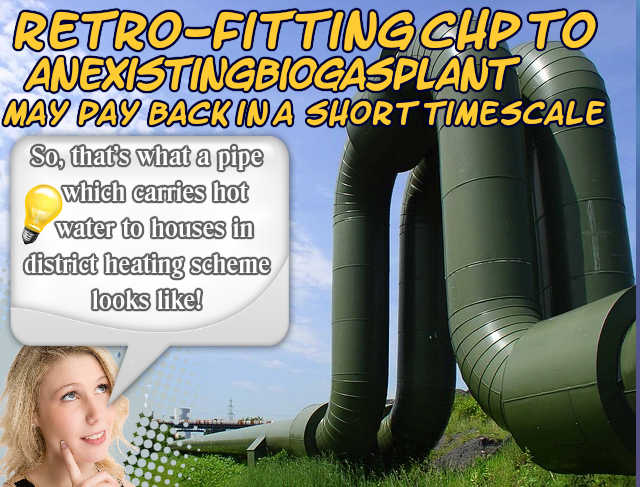
Usually, this heat energy is not used, and goes to a cooling plant, which is usually primarily a radiator and a fan based cooler which vents the heat to the atmosphere. In CHP (combined heat and power) systems, that heat is used in some way, and the most common method is to send the hot water through an insulated pipeline to a space heating radiator in a remote office, or factory, or the hot water delivered may be used to warm more water for industrial hot water uses. The result is that CHP provides a lot more useful thermal energy in an integrated system.

This means that CHP is not a technology, but a concept, there are many ways to apply different technologies to CHP. Heat is used when it would otherwise be wasted during the normal methods of separate generation of heat and power. It is hard to appreciate just how big the benefits of anaerobic digestion heat CHP can be. Experts say that the conventional methods of producing usable heat and power separately usually achieves no better than a combined efficiency of use of the original energy output of 45%, amazingly CHP systems operate at levels as close to 80%. Just stop to think for a moment now, just how wasteful the normal method is.

3 Important Considerations When Designing Combined Heat and Power Systems

  1. Payoffs for adding CHP to an existing biogas generation plant installation can be fast, and as quick as 12 to 18 months, but not always. It is essential to do some detailed analysis of the true value of the heat you will gain from installing heat exchangers to output this useful hot water. The heat (hot water) from any CHP system is only going to be as hot as it now enters the cooling system. Check that this will be hot enough for the purpose the hot water, or heat will be used. For space heating it is usually fine, but just remember that it will not be hotter than the cooling jacket temperature.
  2. Next check the synergy of time. The hot water produced will need to be output at the times when it is needed. For example, if the heat is to be used for crop drying, does the crop drying requirement coincide seasonally with the usage of the generation equipment? That output may be used, in some cases, only at times when the electricity company pays the best rate each day for the power. Conflicts of this sort are likely to occur, and this is not a problem as long as the calculation of the value of the CHP power is done in a way that makes due allowance for them. Although there may be on-farm uses they may prove to give a lower payback than for instance installing a longer insulated pipeline to a nearby factory which has a 24/7 demand for hot process water.
  3. Make sure that you also make a realistic evaluation of the current costs of the power that the CHP energy source would replace. At the current time of writing, electricity tariffs and diesel costs per litre have been dropping due to the low cost of oil. Take a view on the extent to which that drop may continue and build-in a margin for a further potential drop, making sure that the investment decision takes a cautious approach.


You may also find the following article useful:

The Biogas Engine – Defined And How They Provide Biogas Generation of Electricity

There are a number of advanced and proven gas engines utilized for biogas generation by the biogas generator manufacturers. They are maximized for biogas use, in a way that ensures that their combustion chambers provide the highest degree of performance possible.

Lubricating oil is dispersed throughout the engine’s moving components to keep the tool running smoothly as well as to lower wear. Proper treatment and also upkeep of the generator engine will certainly guarantee many years of problem complimentary usage.

Nevertheless, failure to deal with normal upkeep is a sure means to attractive trouble. This is definitely real when it comes to the engine’s lubricating oil.

The post The Biogas Engine – Defined And How They Provide Biogas Generation of Electricity appeared first on Anaerobic Digestion Community Website.

via The Biogas Engine – Defined And How They Provide Biogas Generation of Electricity

Wednesday, November 04, 2015

Availability of Vast Untapped Biogas Energy Confirmed in 2 New Reports

Anaerobic energy has had a good week. It is being heavily backed, firstly by the big guns at the UN, in a new report, and by a biogas technology company showing evidence that by autoclaving ("pressure cooking") black bag (mixed) residual waste a quadrupling of the biogas can be achieved.

This abundance is amazing, and estimates of the amount of energy available from the AD process just keep rising!

We have included extracts from the original articles below:

"Vast Biogas Energy Potential in Human Waste"

Biogas from human waste, safely obtained under controlled circumstances using innovative technologies, is a potential fuel source great enough in theory to generate electricity for up to 138 million households – the number of households in Indonesia, Brazil, and Ethiopia combined.
A report from UN University’s Canadian-based Institute for Water, Environment and Health estimates that biogas potentially available from human waste worldwide would have a value of up to US$ 9.5 billion in natural gas equivalent.
And the residue, dried and charred, could produce 2 million tonnes of charcoal-equivalent fuel, curbing the destruction of trees.

Experts say, that the large energy value would prove small relative to that of the global health and environmental benefits that would accrue from the safe treatment of human waste in low-resource settings. 
“Rather than treating our waste as a major liability, with proper controls in place we can use it in several circumstances to build innovative and sustained financing for development while protecting health and improving our environment in the process,” according to the report, “Valuing Human Waste as an Energy Resource.”
The report uses average waste volume statistics, high and low assumptions for the percentage of concentrated combustable solids contained (25 – 45%), its conversion into biogas and charcoal-like fuel and their thermal equivalents (natural gas and charcoal), to calculate the potential energy value of human waste.
Biogas, approximately 60% methane by volume, is generated through the bacterial breakdown of faecal matter, and any other organic matter, in an oxygen free (anaerobic) system.

Dried and charred faecal sludge, meanwhile, has energy content similar to coal and charcoal.UN figures show that 2.4 billion people lack access to improved sanitation facilities and almost 1 billion people (about 60% of them in India) don’t use toilets at all, defecating instead in the open.
If the waste of only those practicing open defecation was targeted, the financial value of biogas potentially generated exceeds US$ 200 million per year and could reach as high as $376 million.
The energy value would equal that of the fuel needed to generate electricity for 10 million to 18 million local households. Processing the residual faecal sludge, meanwhile, would yield the equivalent of 4.8 million to 8.5 million tonnes of charcoal to help power industrial furnaces, for example.
via Vast Biogas Energy Potential in Human Waste - Solar Thermal Magazine

Below is an extract from the Waste Management World article:

Autoclaved MSW Could Quadruple Biogas Production from Anaerobic Digestion

Waste Management World - Aerothermal Group, has published research which is claimed to prove that pre-treating black bag municipal waste in an autoclave before sending it to anaerobic digestion could increase methane generation by over 300% and substantially reduce the amount sent to landfill... and more »

The above articles vindicate our faith in the huge and ever-rising importance of anaerobic digestion and biogas, which we have reported in this blog for almost 10 years.

Sunday, October 25, 2015

Anaerobic Digestion vs Composting - Which Is Best? A Westerners' Opinion*

This article has been created to answer the question Anaerobic Digestion vs Composting, which is best?

As videos are so popular now, we also created a video which has the same text as this article. If you prefer to watch a video, you are welcome to watch the video below. 


This question is often asked by people who are interested in what their rates (local taxes for household waste collection and disposal) are being spent on, and whether there are better options.

These people often live in a district where they have known that their green garden waste is being sent to a composting facility, or it is proposed that in future it will be sent to one. They may also have heard that this type of waste can also be sent to an anaerobic digestion (AD) plant.

Either method is better than sending this waste to a landfill, but which of these two alternative methods is really best?

* "A Westerner's Opinion"; refers to the fact that what circumstances vary so much in the developing nations that what may be "best" in the developed west may not necessarily be best in the developing nations.

Anaerobic Digestion vs Composting - Our Opinion

In such circumstances, lower initial capital investment needed to start a composting facility than is needed for an AD Plant, but spending that money provides a facility which is much more environmentally sustainable.

The reason that anaerobic digestion is much more environmentally sustainable is due to the fact that it creates a form of renewable energy that is extremely valuable. and it does so with the smallest carbon emissions possible.

That energy is produced in the biogas output, but in addition, just like composting the AD process also produces a fertiliser and that fertiliser is as good or better than that produced by composting.
In fact, the fibrous output from a green waste AD plant still needs to be "composted" after it has passed through the anaerobic digestion process, if it is to be used as a high quality organic compost for improved crop growth.

Many people consider that composting is not environmentally friendly because it consumes a lot of fossil fuel, to make it. This is for its transportation and for energy used during the composting process to turn it over regularly and then after it has matured, to sieve it and remove the large particles.
So to conclude, the common view is usually that, anaerobic digestion is best, but if it cannot be done for any reason, composting is the second best.

In fact, a good strategy for a community seeking to become more environmentally sustainable, may be to start by building a composting facilty, and then add an anaerobic digestion plant to the facility later.

We found some other articles on this subject, which you might find interesting, below:

Several states and major metro areas recently implemented bans on food Anaerobic Digestion Benefits With rapid population growth and industrialization, the amount of organic waste we produce has greatly increased. Organic waste is produced in many forms like food waste, human and animal waste, and agricultural waste. Organic waste is not actually a 'waste' if handled properly. ... Kitchen waste may contain non-organic material like plastic-packaging, which cannot be digested or composted. Human and animal fecal waste; Agricultural waste: It ... Credits: Organic Waste Recycling by Anaerobic Digestion - Energy Recyclers

Anaerobic digestion can be used to prevent waste going to landfills and, instead, indicated sending the discarded food to composting or anaerobic digestion operations. Wasted food is typically an excellent source of energy in an ... only simple pre-screening often make their way into wet digesters. One such scenario could involve screened and pulped waste collected from a university kitchen or a grocery store's prepared foods kitchen. Credits: Containing Food Waste Contamination Essential for Anaerobic ...

This portable anaerobic digestion system can accept a wide variety of organic waste materials, ranging from kitchen scraps and yard waste to paper products, and generate both liquid fertilizer and energy in the form of biogas ... Credits: This HORSE converts food waste into fertilizer and energy ...

That is our view of anaerobic digestion vs composting, if you think differently, or agree, we would welcome your comments below.


Friday, September 18, 2015

5 Undeniable Advantages of Anaerobic Digestion the Industry Has Failed to Publicize

The UK anaerobic digestion industry has done very well in recent years, with a huge growth in the number of AD Plants, but are new UK government policies are about to reverse all this against a background of media distaste for anything to do with anything mucky, and public apathy?

That there has been great progress is clear from the following quote taken from a recent article published in Resource by Charlotte Morton, Chief Executive of the Anaerobic Digestion & Bioresources Association (ADBA), in which she explains that:

"The [UK] anaerobic digestion (AD) industry recently celebrated the passing of a huge industry milestone, with the announcement that over 400 biogas plants are now in operation as a result of over 600 per cent growth outside the water sector over the past five years.* In total, the AD industry now delivers a combined electrical equivalent capacity (electricity and biomethane) of over 514 megawatts - equivalent to the remaining capacity of one of the UK's nuclear power plants, Wylfa, which is being decommissioned this year.
With almost 100 plants expected to be commissioned by the end of this year, mirroring last year's growth surge in which AD's electrical capacity grew by 40 per cent, the industry's prospects should look encouraging for developers, operators and investors alike. Sadly, however, quite the opposite is true as the government's spending axe has fallen sharply on vital support for renewables."

Read the full article here.

Clearly, the UK government either does not understand the real benefits which AD offers, or is willfully pandering to the whims of the entirely discredited "climate change deniers" which remain within the Conservative party.

The leading trade association within the UK anaerobic digestion says that the industry is working to demonstrate the excellent return on investment, which anaerobic digestion (biogas) plants provides. This advantages are, is in our opinion, not only advantageous for its owners, but also for the government, and society as a whole.

That the message is failing to be made effectively is against common sense, is illogical, and will set back the UK, and the UK's previously benign influence on global decarbonisation by many years.
The media frequently talks constantly about wind, tide, and solar power, but almost never about anaerobic digestion. Within the BBC, the only programme which fairly regularly talks about AD is Countryfile. Elsewhere, heaven forbid that they mention anything as distasteful as waste food, or "sludge". Do they think that nice people would rather not be reminded of their wasteful habits?

And, yet the advantages of anaerobic digestion are real, and substantial, and here are some that seldom get aired, but everyone who knows about AD should be singing these 5 benefits from the rooftops:

1. AD is Cost Effective and Low Risk


The case for AD needs no help from any unfashionable "green" notions, although it has many advantages in this area. AD technology improvements mean that the energy it provides will be cheaper than nuclear by the time England's only new nuclear plant actively in development comes online.

AD provides localised generation without all the inherent risks of huge power station project developments which the government dictates must be implemented without direct government investment. Lack of government investment means lack of control over commercial nuclear plant programmes. The Hinkley Point C Nuclear Facility planned for Somerset, is already 6 years late before building even starts.

At the same time AD is reducing the UK's carbon emissions by four per cent, a huge number for a single technology. It also remains highly questionable how much nuclear saves on carbon emissions when decommissioning energy use and storage for thousands of years is truly factored-in.

2. Benefits to the Local Economy, Improved Agricultural Productivity and Improved UK Global Competitiveness


AD provides benefits to the local economy from employment which employs more people per megawatt than nuclear ever will. It is, according to ADBA already employing 4,500 people, and if the government does not crush the current upward trend, the industry will soon potentially employ over 30,000 more people. These jobs will be in construction, transport, waste collection, manufacturing and engineering.

Who could pretend this potential is not worth protecting? But also, on-site AD is a win-win for the way it boosts the economic and environmental sustainability of farming and enables food production with less imported fertilizer.

But it doesn't stop there. By developing a core of AD businesses with world-class expertise in biogas production and all its uses, the value of the very large export markets that is just starting create for the UK biogas market sector can help massively to re-balance the UK economy toward exports worth billions. The US alone is planning for over 10,000 AD plants within the next 5 years, and that's just one market.

3. Security of Gas Production and Provision of 24/7 Available Electricity


The government has to plan for providing the nation with secure energy sources, sources which can be relied upon in a world of increasing political turmoil. The pressing need for the availability of home-produced gas supplies, is partly why the current UK government is willing to weather the inevitable protests from its core voting supporters from pushing forward with the development of fracking. Why must we frack when we can make biogas?

There is an obvious economic benefit in balancing the intermittency of other renewable, because unless sufficient power is available at all times the nation will suffer hugely costly power cuts. The "baseload" electrical output that AD supplies is capable of doing this, and is much more valuable to the power industry than the unpredictable energy produced by wind and solar. That's proven by the way that the power industry is prepared to pay for it.

So, why build nuclear until all AD feed materials have been used up, when rather than the money being paid to overseas investors it goes back into the pockets of local people through a myriad of agricultural AD plants?

The UK AD industry according to ABDA, if fully developed, can deliver a massive 30% of the UK's domestic gas demand.

AD by generating power locally and reducing the need to ship massive amounts of energy around the country reduces the need to reinforce the national power grid, and ADBA estimates this to be worth about £30 per megawatt hour (MWh).

Don't forget either, that power generated and consumed locally does not end-up unavoidably heating up the wires it flows through. When most of the power comes from no more than a dozen or so regional power stations, as it does now, this energy never reaches the homes and factories it was destined for and is completely wasted. Distributed power of the sort AD provides could reduce these power losses by 30% according to some experts. That means that with AD the UK could scrap 3 power stations, and not replace them!

4.  EU Recycling Target Failure Without AD


AD is the best treatment option for food waste, by the UK government's own declaration. Without AD and large scale separate food waste collections, there is no way that the UK/ England can meet the government's own recycling targets. The public when asked, wants "zero waste" or 100% recycling, so any government which subjects the nation to a failure so undeniable that the nation has to pay EU fines, had better watch out for a major backlash from public opinion.


5. AD is Made for Decarbonising Transport and CHP Heat


Electric cars sound like a great idea, but achieve nothing more than reducing roadside emissions many of which are caused by earlier government policies which encouraged the adoption diesel fuelled cars, is futile if the electricity is made from fossil fuels.

AD plants are increasingly being upgraded to produce a very pure "natural gas" substitute known as biomethane, and new membrane technologies are helping to bring this to many more AD plants. Biomethane from the crude biogas made by AD provides renewable energy in the form of gas. This high energy gas can do much more to help with decarbonising (reducing the carbon emissions of) heavy goods vehicles (HGVs), buses and this gas also happens to be ideal for supplying CHP heat networks otherwise using fossil fuel derived natural gas.

Conclusion

This has been a long article, but the length is also a testimony to the amazing benefits of the AD process, and the skill in recent years of a young AD industry to innovate and develop the technology rapidly.

With all the benefits of AD it is hard to explain them quickly. Will all this be lost to apathy, and a press increasingly incapable of delivering more than a 30 second soundbite?

The message speaks for itself. Do more to spread the word!

We hope that those that have read this article to its fullest, will now be inspired to persuade others, at all potential opportunities of the folly of the present UK governments policies toward AD which, if continued, are most likely to throw another winning UK technology onto the scrapheap like so many other leading UK technologies throughout recent history.

Monday, July 06, 2015

55% Growth in Anaerobic Digestion Capacity in the UK in 2013/14 Announced

The official Anaerobic Digestion UK figures are out, and confirms that there was an amazing 55% Growth in Anaerobic Digestion Capacity in the UK over the 12 months 2013/14. This massive over 50% growth, is described simply as being "significant growth", by WRAP (the compiler of these figures - See the EAEM Press Release, which is copied in full below).

In any other sector this rate of growth would be considered to be huge, and the national press would be full of the achievement. So, why is this latest ASORI report announcement being treated in such a luke-warm manner?

We suggest that the reason for this is that the officials are embarrassed to have missed their own target by a large margin, as follows (see the extract from www.ladoma.com below). The achievement of 117 operational biogas sites in the UK at the end of 2014, showed even then, that they were not going to get anywhere near the government's 2011 target of 1,000 operational AD Plants for 2015, and they could not therefore declare it for the success that it undoubtedly has been.

To help convey how far the projections fall short of the target, we have included below part of an article by Energy and Environmental Management (EAEM) Magazine. This explains that the current operational AD Plant number has been growing a lot more rapidly since that time, with the pace of plant commissioning accelerating. Currently, there are 400 Anaerobic Digestion plants now in use according to EAEM Magazine. 

At this rate the magic figure of 1,000 AD Plants in operation in the UK, will finally only be reached some time in 2017.

AD Sees Significant Growth Says Latest Sector Survey

"
Content
Anaerobic digestion (AD) has grown significantly in the UK, according to the latest sector survey (ASORI), published today by WRAP.
WRAP’s comprehensive study of the AD sector (which complements the Scottish survey of the organics reprocessing industry – also published today, by Zero Waste Scotland*), for the calendar year 2013, shows that:
  • the number of operational sites increased by 34% (up from 87 to 117);
  • operating capacity is up by 55% (from 2.07mt to 3.20mt);
  • 51% more organic material is being processed (from 1.69mt to 2.55mt); and,
  • employment in the sector has increased by 36% (with 482 full-time equivalent jobs compared to 354 in 2012).
In addition, there has been an increase in all the types of feedstocks processed - separated solid food, liquids, manures and crops. However, food and drink waste continues to be the largest proportion of the material processed - with separated solid food accounting for 38% of the feedstocks reported in the survey and liquids 30%.
Food manufacturers and processors provide the biggest proportion of the feedstock, however the volume of material sourced from local authority collections, has increased by more than a third**.
Over a million tonnes of digestate (the product of AD) was applied to agricultural land in 2013 – that’s 98% of total digestate use – demonstrating the benefits of readily available nutrients as well as potentially reducing the reliance on inorganic fertilisers.
Ian Wardle, Head of Organics and Energy at WRAP, said: “It’s fantastic to see such positive results from this survey. The industry is turning a wide variety of wastes into valuable renewable energy and digestate that can be used by farmers as a fertiliser.
“Each year we are seeing the sector grow and this year’s data shows the AD industry is starting to make a marked contribution to the UK economy. Industry has always supported this survey and this year’s excellent response is testament to that.”
The report was commissioned by WRAP, working in partnership with the Renewable Energy Association’s Organics Recycling Group (REAORG), Anaerobic Digestion and Bioresources Association (ADBA), and the Environmental Services Association (ESA). It is widely recognised as the most definitive picture of the organics recycling industry.
The full ASORI report - A survey of the UK Anaerobic Digestion Industry in 2013 - can be found here
Ends
Notes to editors
*The Scottish report - A Survey of the Organics Reprocessing Industry in Scotland 2013 - was managed and delivered by WRAP on behalf of the Scottish Government having been initiated in 2013/14. The survey of Scottish AD sites was part of the UK ASORI project, however the Scottish Government also funded a survey of the composting sector.
**Of the feedstock for which sources were stated, it increased by around 35% from 170,000t to 230,000t.
  1. ASORI – Annual survey of the UK organics recycling industry.
  2. WRAP’s vision is a world without waste, where resources are used sustainably. Working in partnership to help businesses, individuals and communities improve resource efficiency.
  3. Established as a not-for-profit company in 2000
  4. More information on all of WRAP's programmes can be found on www.wrap.org.uk
" http://www.wrap.org.uk/content/ad-sees-significant-growth-says-latest-sector-survey

Recent UK Anaerobic Digestion Developments and Future Projections
"The growth of anaerobic digestion in the UK has not met Defra’s strategy target of 2011, when 1,000 new digesters were to be built by 2015. In fact less than half that figure was achieved, nevertheless the industry has been growing rapidly in real terms in the UK. Considering, the difficult economic circumstances, and reticence […] The post Recent UK Anaerobic Digestion Developments and Future Projections appeared first on Rinobs Renewables. " http://www.rinobs.com/recent-uk-anaerobic-digestion-developments-and-future-projections.html

Anaerobic digestion steps on the gas - Energy and Environmental Management (EAEM) Magazine

"Energy and Environmental Management (EAEM) Magazine. Commissioning of the UK's 400th anaerobic digestion (AD) plant by food waste management company Biogen in South Wales marks a milestone for the industry, in a year which has seen 102 new plants open. The announcement was made at the UK AD ...AD feedstock guidelines get industry backingMaterials Recycling World500% jump in volume of recycled UK food wasteEat Out Magazineall 3 news articles »" http://news.google.com/news/url?sa=t&fd=R&ct2=uk&usg=AFQjCNEZeKkqYMOAeBjsvPOHdXQCbg3Row&clid=c3a7d30bb8a4878e06b80cf16b898331&cid=52778893906734&ei=FMqZVaDLG4y5aInGk5gE&url=http://www.eaem.co.uk/news/anaerobic-digestion-steps-gas

Conclusion

A massive 50% rise in Anaerobic digestion plant numbers (and UK capacity in use) to 117, was recorded in 2013 (the latest year for which data is available).

But, the achievement has been played down by the UK government. We think that the reason for that is, that a target of 1,000 biogas plants was set for 2015, but even now (mid-2015), only 400 have been commissioned, with the knock-on effect that by the end of 2015 there will still be less than half of those 1,000 plants, operating in the country.


The UK/ European biogas industry has been, and still is, growing rapidly and the momentum is growing. We would like to point out that this growth is being achieved, by project promoters, despite uncertainties caused by changes which have been made to the subsidies on offer by the UK government.

More reading: BioCycle Magazine has an article about AD Capacity Expansion here.