Sunday, September 20, 2026

Do Anaerobic Digestion Plants Smell?


It is one of the first questions local residents ask when a new anaerobic digestion (AD) or biogas plant is proposed near their homes.

It is also a perfectly reasonable question.

Anaerobic digestion plants handle organic materials. Depending on the plant, these may include food waste, manure, slurry, crop residues, food-processing wastes and other biodegradable materials. Some of them can produce extremely unpleasant odours if they are stored or handled badly.

So let's start with an honest answer.

Yes, the materials handled at an anaerobic digestion plant can smell. But that does not mean that a properly designed and operated AD plant should cause an unacceptable smell beyond its site boundary.

Do Anaerobic digestion plants smell?

Those are two very different things.

Where Does the Smell From an AD Plant Actually Come From?

Interestingly, the sealed anaerobic digester itself should not normally be the main source of odour.

The biological process takes place inside enclosed tanks or vessels because the microorganisms need oxygen-free conditions. The biogas produced is also valuable, so operators have every reason to keep the digestion system gas-tight.

The greater potential for odour generally arises around the handling of materials before and after digestion.

Potential sources can include:

  • delivery and unloading of food waste and other odorous feedstocks;
  • feedstock reception and storage;
  • depackaging and preprocessing equipment;
  • open doors and poorly contained reception areas;
  • spillages;
  • digestate storage and handling;
  • solid-liquid separation equipment;
  • maintenance operations;
  • abnormal operating conditions; and
  • the application of digestate to agricultural land.

The precise risks depend heavily on the type of AD plant.

A farm digester processing mainly slurry and crops presents a different odour-control challenge from a commercial food-waste AD plant receiving packaged and potentially decomposing food from many sources.

What Does Digestate Smell Like?

Digestate is the material remaining after anaerobic digestion has converted part of the biodegradable organic matter into biogas.

It can certainly have a noticeable odour, but it is misleading to say that all digestate invariably smells extremely unpleasant.

The character and strength of the odour depend on such factors as the original feedstock, digestion conditions, process stability, storage, subsequent treatment and how the digestate is handled.

Digestate may also be separated into liquid and solid fractions, creating materials with different handling characteristics.

The important point is that digestate remains an organic material containing valuable plant nutrients. It therefore needs to be stored and applied responsibly.

Good AD Plant Design Starts With Containment

One of the fundamental principles of odour control is straightforward:

Don't allow odorous air to escape uncontrolled in the first place.

At facilities handling particularly odorous wastes, reception and processing operations can be carried out within enclosed buildings.

Air can be extracted from these areas so that the building is maintained under suitable containment conditions rather than allowing contaminated air to escape through doors and openings.

The extracted air can then be treated using an appropriate odour-abatement system before discharge.

Depending on the application, such systems may include biofilters and other biological, chemical or physical treatment technologies.

There is no single odour-control technology which is automatically correct for every AD plant. The system needs to be designed for the characteristics and loading of the air requiring treatment.

An Odour-Control System Also Has to Keep Working

Installing an odour-control system is not enough.

Fans fail. Ductwork deteriorates. Filters require maintenance. Doors are left open. Feedstocks change. Operators may receive unexpectedly odorous loads.

That is why good odour management combines engineering with operating discipline.

Operators need to understand where odour could arise, monitor the important parts of the process and have procedures for responding when something goes wrong.

This is particularly important because some of the worst odour incidents at waste-treatment facilities occur during abnormal rather than routine operation.

What Does the Environment Agency Require?

Environmental regulation has developed considerably since I first wrote this article.

In England, the Environment Agency published updated guidance on odour management in December 2025.

For regulated activities, operators are expected to assess their odour risks and use appropriate measures to prevent odour pollution or, where prevention is not practicable, minimise it.

Anaerobic digestion is specifically included among the activities for which an Odour Management Plan (OMP) may be required as part of environmental permitting.

An OMP is not supposed to be a vague statement saying that an operator will try not to create smells.

It should identify the potentially odorous materials and processes on the site and explain how risks will be controlled.

This can include:

  • feedstock and waste inventories;
  • maximum storage times;
  • storage conditions;
  • process controls;
  • containment;
  • air extraction and abatement;
  • monitoring;
  • performance standards;
  • record keeping;
  • responses to abnormal conditions; and
  • contingency arrangements.

The Environment Agency's current permit requirements are aimed at preventing odour at levels likely to cause pollution outside the permitted site boundary.

If a facility does cause odour pollution, the regulator can require further controls and changes to operating practices. Serious or persistent failures can lead to stronger regulatory action.

What Should Local Residents Look For in a Planning Application?

If you live near the site of a proposed anaerobic digestion plant, I don't think it is helpful simply to be told that "AD plants don't smell".

A better approach is to look at what is actually proposed.

Some useful questions are:

  • What feedstocks will the plant accept?
  • Will particularly odorous materials be unloaded indoors?
  • How will reception buildings be contained and ventilated?
  • How will extracted air be treated?
  • How long can incoming material remain in storage?
  • How will digestate be stored?
  • What happens if the odour-abatement equipment fails?
  • How close are the nearest homes and other sensitive receptors?
  • Is there a credible Odour Management Plan?

Those questions tell you considerably more about the likely risk than simply knowing that the development is called an "anaerobic digestion plant".

Visit an Existing AD Plant

There was one suggestion in the original version of this article that I still think has considerable merit.

If you are concerned about a proposed AD plant, find an established plant of a similar type and visit the surrounding area.

You obviously should not enter private operational premises without permission, but it may be possible to experience conditions from public roads or other legitimate public locations.

Ideally, don't just visit one plant once. Weather conditions, wind direction and plant operations vary.

Nevertheless, seeing an operating AD facility can be much more informative than trying to imagine one from drawings in a planning application.

My Own Experience of AD Plant Odour

In the area where I lived when I originally wrote this article, there were several anaerobic digestion plants relatively close by.

My personal experience was that I did not routinely detect odour from those plants beyond their sites.

On occasions when I did notice agricultural odours in the surrounding countryside, the source was not necessarily the AD plant at all. Normal agricultural operations can themselves generate substantial odour.

That is only my personal observation. It is not evidence that every AD plant is odour-free.

There have unquestionably been AD facilities where poor design, inappropriate feedstock management, equipment problems or inadequate operation have resulted in legitimate complaints from neighbours.

That is precisely why odour needs to be considered seriously during design, permitting and operation.

So, Do Anaerobic Digestion Plants Smell?

The most accurate answer is:

The materials handled at anaerobic digestion plants can be highly odorous, but a well-designed and well-operated AD plant should control those emissions rather than routinely subject its neighbours to them.

It would therefore be wrong to dismiss residents' concerns about odour.

But it is equally wrong to assume that because anaerobic digestion involves decomposing organic material, every AD plant must inevitably make the surrounding area smell.

The questions that matter are about feedstock, design, containment, abatement, management, monitoring and operator competence.

That is where residents, planners and regulators should concentrate their attention.

Steve Last
Chartered Civil & Environmental Engineer (MICE)
Chartered Waste Manager (MCIWM)
Chartered Environmentalist (CEnv)


Updated September 2026. This article was originally published many years ago (on 8 January 2015) and has been substantially revised to reflect current anaerobic digestion practice and Environment Agency odour-management guidance.

Further reference: Environment Agency, Odour management: comply with your environmental permit, published December 2025.

UK Biomethane Could Grow Tenfold — But Where Will All the Feedstock Come From?

UK Biomethane Could Grow Tenfold but where is the feedstock?

There is a very large number appearing increasingly often in discussions about the future of anaerobic digestion in Britain.

64 TWh of biomethane a year by 2050.

The Parliamentary Office of Science and Technology (POST) highlighted this figure in its recent briefing on upscaling anaerobic digestion. One of the National Energy System Operator's Future Energy Scenarios suggests that UK biomethane production could need to reach around 64 TWh annually by 2050.

POST describes that as approximately a tenfold increase from current biomethane production levels.

That sounds like extremely good news for the UK anaerobic digestion industry.

And potentially it is.

But there is a question which I think needs asking before we start mentally filling the British countryside with another generation of digesters:

What are we going to put into them?

Building Digesters Is Only Half the Problem

An anaerobic digestion plant isn't like a wind turbine.

Once a wind turbine has been built, nobody needs to find thousands of tonnes of wind and deliver it to the site every year.

An AD plant is fundamentally different.

Every digester requires a continuing supply of suitable organic feedstock. That supply has to remain available not just when the plant is commissioned, but year after year if the investment is to succeed.

The UK already has hundreds of AD plants competing for food waste, agricultural residues, industrial organic wastes, crops, slurries and other suitable materials.

Expanding biomethane production several times over therefore isn't simply an engineering challenge.

It is a feedstock challenge.

There Is Plenty of Organic Material — But Not All of It Is Available Feedstock

POST notes that the UK produces around 10.2 million tonnes of food waste annually.

England's requirement for separate weekly household food-waste collections should make considerably more source-separated organic material available for treatment, and anaerobic digestion is an obvious destination for much of it.

Agriculture offers further possibilities through manures, slurries, crop residues and other organic materials.

But theoretical quantities should never be confused with economically available feedstock.

Material may be dispersed across too large an area. It may already have another use. Transport may make collection uneconomic. Seasonal availability can create difficulties. Contamination can make apparently attractive waste streams unsuitable.

And where several AD plants are seeking the same material, something else happens:

the feedstock acquires a value.

Competition for Food Waste Is Already Important

This is particularly relevant to food-waste AD.

As more separately collected food waste becomes available under Simpler Recycling, it is tempting to assume that this automatically creates an enormous supply of cheap feedstock for new digesters.

I wouldn't make that assumption.

Established food-waste AD operators already have collection networks, contracts, depackaging systems, tankage and relationships with waste producers.

If new biomethane plants are constructed in the same catchments, competition for dependable feedstock may increase.

A developer therefore needs to know considerably more than how many tonnes of organic waste theoretically arise within 30 miles of a proposed site.

They need to know who controls it, what it currently costs, who else wants it and whether it can realistically be contracted for the life of the project.

I have discussed this problem in more detail here:

Finding the Right Feedstock for Anaerobic Digestion Plants

What About Energy Crops?

Purpose-grown crops can provide predictable feedstock and high biogas yields, which is precisely why crops such as maize became important to parts of the European AD industry.

But increasing their use substantially brings the familiar food-versus-fuel and land-use debate straight back into the discussion.

There are also policy constraints.

The Green Gas Support Scheme requires supported biomethane plants to meet sustainability requirements intended to encourage the use of wastes and residues.

So a theoretical shortage of waste feedstock cannot simply be solved by planting unlimited areas of energy crops.

And Feedstock Isn't the Only Constraint

Even where suitable feedstock can be secured, Britain will not obtain a tenfold increase in biomethane simply by ordering more digesters.

Projects also require suitable sites, planning permission, environmental permits, finance, gas-grid connections or alternative biomethane outlets, digestate storage and dependable agricultural outlets for the resulting nutrients.

Anyone who has developed an AD project will recognise that some of these constraints can take longer to resolve than designing the digester itself.

That is particularly relevant at present because developers are reporting increasing difficulty obtaining planning permission for completely new AD plants on some greenfield and farm locations.

64 TWh Isn't the Only Estimate

There is another important point which can easily disappear when large numbers are quoted.

The 64 TWh figure is a scenario rather than a guaranteed government target.

The UK Government has also referred to its 2023 Biomass Strategy, which estimated around 30–40 TWh of biomethane production by 2050 across its illustrative scenarios.

In September 2026, the Department for Energy Security and Net Zero confirmed that it is considering this evidence while developing future policy for biomethane.

So the precise number remains uncertain.

What seems much less uncertain is the direction of travel: Britain expects biomethane to play a substantially larger role in its future energy system.

The Opportunity Is Real — But So Are the Practical Limits

I remain enthusiastic about the potential for UK biomethane.

It converts organic wastes into useful renewable gas, recycles nutrients through digestate and can make use of much of the country's existing gas infrastructure.

It also offers something increasingly important in a world of volatile international energy markets: domestically produced renewable gas.

I recently looked at that energy-security argument in more detail here:

How UK Biomethane Could Cut Gas Prices and Boost Energy Security

But ambitious biomethane scenarios need to be tested against what can actually be delivered.

That means asking some rather less glamorous questions:

Where is the feedstock?
Who controls it?
How far will it travel?
Where will the digestate go?
Can the project obtain planning permission?
Where will the biomethane be used?
And will the economics still work when competing plants are bidding for the same organic material?

Those questions don't undermine the case for expanding anaerobic digestion.

They are what determine whether that expansion will actually happen.

Steve Last
Chartered Civil & Environmental Engineer (MICE)
Chartered Waste Manager (MCIWM)
Chartered Environmentalist (CEnv)


Sources: Parliamentary Office of Science and Technology, Upscaling Anaerobic Digestion, July 2026; Department for Energy Security and Net Zero, Parliamentary Written Answer on domestic renewable gas production, 7 September 2026.

Monday, September 14, 2026

Australia's Biomethane Market Is Starting to Look Much More Interesting

Australia's Biomethane Market Is Starting to Look Much More Interesting


For many years, Australia has had plenty of potential for biogas but relatively little visibility as a biomethane market.

That is beginning to change.

I have been watching developments in anaerobic digestion and biogas internationally for many years, and Australia is now one of the countries I think is particularly worth watching.

The important change is not simply that more people are talking about biogas. It is the increasing interest in upgrading biogas to biomethane so that renewable gas can potentially replace fossil natural gas in applications where direct electrification may be difficult.

Why Australia Has Considerable Biomethane Potential

Australia has many of the ingredients needed for a substantial biogas and biomethane industry.

These include agricultural residues, livestock manures, food and beverage processing wastes, municipal organic wastes, sewage sludge and other biodegradable materials that can potentially be treated through anaerobic digestion.

Historically, the economics of biogas projects have often centred on using the gas locally, particularly for heat or combined heat and power.

Biomethane changes the possibilities.

Raw biogas typically contains methane together with a substantial proportion of carbon dioxide and smaller quantities of other gases and contaminants. By removing carbon dioxide and treating the gas to the required specification, the methane-rich product can potentially be used much more like conventional natural gas.

That opens possibilities including gas-network injection, industrial energy use and renewable transport fuel.

Renewable Gas Can Do Something Electricity Cannot Always Do Easily

I am wary of arguments that present renewable gas and electrification as though one must defeat the other.

They solve different problems.

Where electricity can efficiently replace fossil fuel use, electrification may make excellent sense. But some industrial processes, heavy transport applications and existing gas infrastructure present more difficult decarbonisation challenges.

In those circumstances, biomethane produced from appropriate wastes and residues may have a valuable role.

It also has the advantage that anaerobic digestion does more than produce energy. Properly designed projects can simultaneously provide organic-waste treatment and produce digestate containing plant nutrients and organic matter.

From Individual Projects to an Industry

The interesting question for Australia is therefore no longer simply:

"Can biomethane be produced here?"

Clearly it can.

The more important question is whether individual projects will develop into a sufficiently connected market involving reliable feedstock supplies, gas upgrading, appropriate standards, infrastructure, investment and long-term demand for renewable gas.

That transition from a collection of projects to an established industry is what makes the present period interesting.

I recently updated my longer article examining the subject, including Australian biomethane projects, policy and the developing renewable-gas market:

Biomethane in Australia: Projects, Policy and the Emerging Renewable Gas Market

I expect this will be a page that needs updating again as the Australian market develops.

Bringing This Old AD News Blog Back to Life

I have also decided to start posting here again after neglecting this blog for a while.

Rather than duplicate the longer articles published elsewhere, I intend to use this blog for shorter observations on anaerobic digestion, biogas and biomethane developments that I think are worth drawing attention to.

There is certainly no shortage of developments to discuss.

Steve Last
Chartered Civil & Environmental Engineer (MICE)
Chartered Waste Manager (MCIWM)
Chartered Environmentalist (CEnv)

Sunday, March 06, 2022

Suppliers of Food Waste Depackaging and Separation Equipment Listed

 Make no mistake, there have been significant advancements in food waste depackaging and separation equipment in recent years. 

The industry is moving away from first-generation equipment, which consisted of repurposed machines originally designed for MSW sorting, milling, pulping, paper, and card and shredding, and toward purpose-built models that are the result of many years of innovative design.


List Criteria: Depackaging and Separation Machines

We looked for the following characteristics in the listed equipment:

  1. Acceptance of a diverse range of biowastes, ranging from OFMSW (Organic Fraction of Municipal Solid Waste) to "Out of Specification." Food-processing-industry-related products
  2. Off-the-shelf, tried-and-true designs are preferred over one-of-a-kind, custom-designed prototype equipment.
  3. A process philosophy which avoids creating microplastics.

In contrast to suppliers who offer separate units for each function, such as bagging, the new generation of this equipmentis integrated and carries out multiple functions in a single process stage.

such as bag opening and shredding followed by separation and sometimes multiple other units

Suitability for the equipment to be used in conjunction with the anaerobic digestion process.

The best depackaging equipment will separate and capture organic packaging materials from food waste, and also separate and recycle as much of the reject material (e. g. plastics) as possible.

Subject to regulatory requirements, operators of the new generation of this equipment will be able to benefit from green credentials. These come from reclaiming the organic content of food waste and incorporating it into the highest purity quality, natural compost and sustainable soil products.

In the post CPO26 era, all businesses must not only act in a sustainable way but also make plans and publish targets to decarbonise their whole organisations by 2050 or earlier. One way to do this for any organisation which produces food waste, and even some other previously unused organic materials, is to carry out their own in-house depackaging and separation.

An example of government involvement in this process is the US Food Waste Management Program. This scheme is addressing a major issue of our time that directly affects the human and ecological balance of the environment. That is by reducing methane emissions while also creating renewable energy to displace the use of fossil fuels.

There is no doubt that climate change can be reduced by reducing food waste, and recycling more. Where unavoidable waste still occurs it makes sense to channel it back into the circular economy. 

Efficiently depackaging food waste is a key component in this area.

According to the USDA, food waste represents 30 % of all American food manufactured. This can be due primarily to over-consumption in the homes and subsequently. In food production, there are evidently still many wastes generated in even the most sophisticated manufacturing facilities.

We have compiled our waste depackaging and separation equipment supplier list as a resource for all organic waste/ biowaste processors in the hope that we can assist in the selection of the most suitable equipment for their purchasing decisions.

For our list go to our list of food waste depackaging and separation suppliers here.

Friday, February 25, 2022

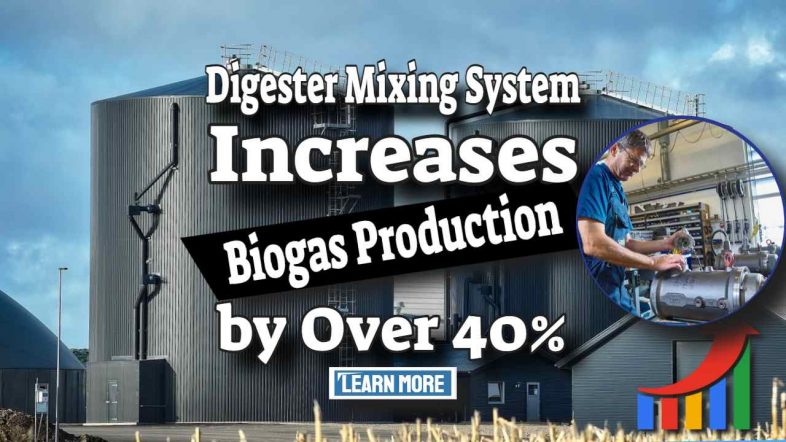
Case Study: Digester Mixing System Increases Biogas Production by Over 40%

New digester mixing technology has helped a prominent food waste-to-energy plant enhance its biogas production by an average of more than 43%.

Biogas yields have been improved by Landia and Hayley Group working together closely.

Hayley Group, an engineering component supplier, was consulted about the availability of an alternative, superior mixing system for its customer's second digester; mixers that, unlike those in the first tank, would eliminate typical biogas process problems such as foam, blocking, and crusting – and in doing so, help boost the levels of methane in the gas.


Hayley Group’s Engineer, Rob Bentley, said:

“We constantly look to help customers improve efficiencies. This project is of particular note because, with the new, superior mixing system, the increase per cubic metre in gas from the second digester is over 40%. This is extremely encouraging, to say the least, especially when you consider that the second digester also has 10% less capacity than the older first tank”.

Visit: www.blog.anaerobic-digestion.com/digester-mixing

Sunday, January 23, 2022

Anaerobic Digestion Costs - The Short Answer


We'll look at how much anaerobic digestion costs in general in this article. 

We also go over other basic rules of thumb to assist folks who are trying to figure out how much a biogas digester will cost in our main article here.

Capital Expense

Depending on the size of the facility and the technology employed, a commercial microbial anaerobic digester can cost anywhere from $400,000 to $5,000,000 to develop. An anaerobic digestion plant on a farm costs about $1.2 million dollars on average.

Operating Costs

In 2022, a medium-sized commercial on-farm digester with 250 cows will cost around $0.30 to run all-in. Electricity sales will bring in around half of that.

Upgrading to biomethane raises costs, but in the appropriate circumstances, it can pay for itself.

Profitability in power generating is dependent on additional revenue from sources such as:

Entrance fees

  • Subsidies from the government
  • Sales of digestate as a natural fertiliser (liquid and fibre), bedding material (fibre), and insulating product (fibre)
  • On-farm or through delivery to a local greenhouse, business, or housing complex, combined heat and power (CHP) is used for home heating.

It is often possible to assure the profitability of a biogas plant by creative thinking and even by coming up with a unique "out-of-the-box" solution.


Tuesday, December 21, 2021

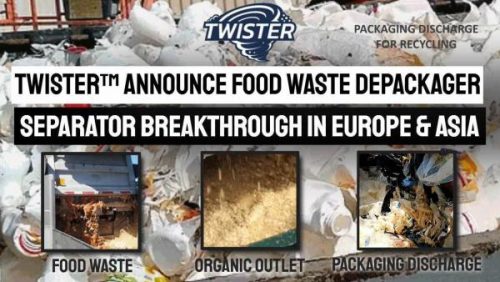
Food Waste Depackager Separator by Twister is a Breakthrough in Vortex Technology

When compared to competitors, the Twister Food Waste Depackager and Separator is breaking into new markets thanks to its low microplastics output and low energy consumption.


Twister announced today that their innovative Food Waste Depackager and Separator has been purchased by new customers in Europe and Asia. In the increasing EU and Asian markets, the small-footprint, low-energy-use plastic waste reprocessing facility has established itself.

Since 2016, it has been in the works. It's a decentralised organic processing system with exceptional separation performance that was recently introduced in Canada.

Each opened, empty, and full box is ejected. The "Twister" effect produces clean food waste that is free of microplastics and suitable for anaerobic digestion.

"We wanted something distinctive for Drycake's Twister," explains Mark Vanderbeken, Chairman and Founder of Drycake®.

"Anyone familiar with the food waste depackaging industry will have noticed that everyone else looks to start their depackaging and separation of source-separated organics by reducing particle size." This is how most competing depackagers avoid congestion. They mill, macerate, cut, or shred the plastic to make it into little pieces. Larger pieces, on the other hand, are easier to separate than tiny ones, so why not combine the depackaging and separation processes?"

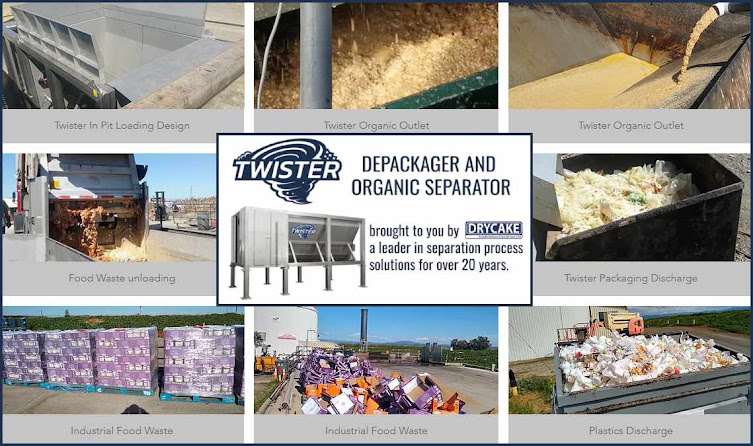
Food Waste Depackager Separator from Twister (TM)

So DryCake went back to the drawing board and came up with a method that doesn't require any cutting and isn't dependant on reducing particle size by processing plastic. In actuality, they use shear forces and vibration to open and remove biological matter in a high-speed vortex, causing as little injury as possible while making as little microplastics as possible.

As a result, it has established itself as a market leader in terms of sustainability by reducing the risk of environmental damage caused by plastic pollution. Due to rising evidence of "ocean microplastic ingestion," which is hurting ocean plankton and the food chain that sustains all marine life, Drycake adopted this course of action.


Slicing, bashing, and crushing these materials likewise consumes a lot of energy. Hammer mills, blades, and knife openers all have moving components that wear out and need to be replaced. As a result, the Twister only has a few moving parts.

"It must be preferred to avoid breaking up plastic wrapping wherever possible."

Mark continued, "Then you won't manufacture those microplastic particles in the first place."

As a result, Drycake predicted that this invention would be in high demand right away. This company has strong prospects to disrupt the market and become the industry-standard depackager provider in Europe and Asia, with considerable environmental benefits.

On the one hand, they want to provide their clients the option of running sustainable plastic recycling businesses, reprocessing garbage into resin for use in new packaging as part of the "circular economy," which is vital to averting runaway climate change. While also providing biogas facilities with a high-quality organic paste.


They may offer this mixture, or "organic soup," as feedstock to anaerobic digestion plant operators, allowing them to create renewable energy in the form of biogas refined to biomethane. Renewable Natural Gas (RNG) is compressed biomethane that may be injected into town and city gas mains to heat our homes.

It's also ideal for use as a low-emission transportation fuel throughout the transition to hydrogen technology.

Twister is also a novel concept, as its target market is larger than city/regional MRFs and ERFs (Energy Recovery Facilities/ Incinerators). The small size is ideal for several locations around a city, reducing RCV travel distances, lowering collecting costs and emissions, and improving food waste collection efficiency.

Waste collection employees will spend more time on the street collecting rubbish and less time sat in the cabs of their RCVs en route to the MRF ERF or transfer station as a result of the Twister unit distribution. Drycake will also design the entire process, as well as the facility, if necessary.

Twister's low energy use, low carbon footprint, simple maintenance, and high uptime are all features they wish to impress their clients with. It's a sound long-term investment that's also environmentally friendly.

In fact, supermarkets, organisations, and institutions that run catering facilities, as well as clients in the food and beverage industry, may discover that purchasing just one Twister unit will help them achieve their sustainability goals. As a consequence, their company's carbon footprint is reduced, and they may proudly showcase their really green achievements for years to come.

It's always a risk to try anything new, but they feel it's one worth taking. In this circumstance, not least to contribute to the global environment's preservation and to develop a product that would help in the attainment of Net-Zero Carbon 2050 emission targets.


How Twister, a vortex-based food waste depackager, Outperforms Rivals

Twister Food Waste Depackager technology accomplishes this in four different ways:

1. Combining two operations into a single unit to save energy and water.

2. Reducing dependency on fossil fuels (e.g., oil), which produce much more "greenhouse gas" carbon when things are made from virgin plastic resins instead of recycled.

3. By transforming food waste into a plastic-free paste or slurry that may be used to power a biogas plant, which provides sustainable energy while emitting very little net carbon dioxide. This eliminates the need to develop oil or gas geological deposits once more.

4. When organic slurry is digested and applied to agricultural land, it decreases carbon emissions by reducing the requirement for chemical fertilisers on the part of the farmer. Traditional fertilisers are derived from geological deposits. They need a lot of fossil fuel to extract and transport them, therefore this notion contributes even more to environmental preservation.

Conclusion on the Twister Food Waste Depackager

Drycake has been a global leader in separation solutions since 1995. Since its founding, it has provided market-disrupting process equipment and design for sustainable waste reuse, recycling, and energy recovery on a global scale.

This isn't the first time Drycake has gone against the grain. They previously made a splash with the Plastifloat, a waste reuse and materials recovery system for municipal and industrial wastewater. A straightforward yet effective method for extracting plastic from liquids.

Drycake has grown into Europe and Asia, in addition to previous sales in the Americas, and the Twister Food Waste Depackager is aiming for global recognition. More information may be found in the following article: Vortex Depackager and Separator by Twister

Visit https://www.twisterseparator.com for more details.

Also see https://drycake.com for more information.


Saturday, July 03, 2021

Methane Mitigation – World Biogas Summit 2021 Will Be “All About Methane”

 “Methane Mitigation” which can be defined as using the anaerobic digestion (i.e. biogas production process) to help humanity in the fight against climate change, is the core subject announced for the World Biogas Summit 6 -8 July 2021.

It will be “All About Methane”!

Find out more by reading the ADBA Press Release reproduced below:


WBA Press Release 29 June 2021:

International Energy Agency and Climate and Clean Air Coalition to headline the “It's all about the methane” World Biogas Summit 2021


Held online from 6th to 8th July, the World Biogas Summit 2021, organised by the World Biogas Association (WBA), will feature Keisuke Sadamori, Acting Deputy Executive Director of the International Energy Agency and Drew Shindell, Special Representative for Action on Methane, Climate and Clean Air Coalition as keynote speakers – leading an impressive line-up of eminent figures from not only the global biogas sector but also from the worlds of finance, retail and urbanism.

This year's event held virtually due to the Covid-19 pandemic,  will focus on how, in the build-up to COP26,  AD and biogas can help reduce global methane and other greenhouse gases (GHG) emissions.  In particular, it will explore the need to capture and recycle the 105bn tonnes of organic wastes generated by human activity every year – and turn these wastes into a valuable resource (1).

Portrait of Keisuke Sadamori - Keynote presenter
Keisuke Sadamori – Keynote presenter.

Entitled “It's all about the methane”, the 2021 Summit programme will review how to efficiently capture organic wastes, recover the gases and nutrients they contain and recycle them in the form of clean energy and natural fertilisers – achieving GHG emissions savings, displacing fossil-based equivalents, restoring soil health and helping reduce the carbon footprint of hard-to-decarbonise sectors such as heat, transport, agriculture and waste management – thus contributing to countries meeting their Net Zero targets.

Ahead of his address, CCAC's Drew Shindell said: 

Methane mitigation is one of the most significant climate actions the world can take this decade. There are cost-effective solutions that can be implemented immediately, and the benefits far outweigh the costs. The world needs to make 2021 a ‘methane moment,’ by committing to implement policies and measures to rapidly reduce methane emissions and working to drive a decade of methane action.”


Click on the image above to find out more!

There's no Net Zero without Biogas: ending waste, delivering the circular economy, tackling the climate crisis. 

Friday, June 25, 2021

Use of Biomethane Decarbonises Heavy Vehicles Now - Unlike Hydrogen and Battery Power

"Biomethane the key option to decarbonise heavy vehicles immediately";

 says trade body in a new publication     


Biomethane: Fuelling a Transport Revolution reviews how the anaerobic digestion and biogas industry can help decarbonise heavier modes of transport, such as trucks and buses, much sooner than electricity or hydrogen.

·         The Policy Briefing report by the Anaerobic Digestion and Bioresources Association (ADBA) details the GHG emissions issues facing the UK transport sector and explores the solutions available for heavy goods and public transport vehicles, which alone generate 20% of current emissions per year.

·         Rapid deployment of biomethane for HGVs could reduce GHG emissions by 38% over the next 10 years. Current technological barriers to powering heavy vehicles with electricity or hydrogen mean these future fuels could only cut emissions by 6% over the same period.

·         Major fleet operators are already making the transition to biomethane trucks and buses.

·         Fuelling HGVs with biomethane can cut well-to-wheel emissions by 80% per km driven and greatly improve air quality.

·         As well as decarbonising transport, biomethane can boost an entire economic sector, with ROI for hauliers achieved within two years of operation.

Earlier this month, the Anaerobic Digestion and Bioresources Association (ADBA) launched a Policy Briefing report demonstrating the crucial role biomethane could play in decarbonising transport in the UK in the short-term.


In the first of a series of Policy Briefing Events, the trade body presented Biomethane: Fuelling a Transport Revolution, which analyses the UK transport sector's issues and explores the options presented by electric vehicles, hydrogen and biomethane. 

The research highlights the value of biomethane in providing a green fuel alternative for heavy good and public transport vehicles - immediately. Trucks and buses currently generate 20% of the UK's greenhouse gas emissions from transport, which is itself the highest GHG emitting sector in the UK (27%).

" Transport is the most polluting sector and its GHG emissions levels have not changed over the past decade. "

, explains Charlotte Morton, ADBA's Chief Executive.  

"Biomethane is ready to be produced, ready to be used, and can decarbonise heavy vehicles transport here and now. At time when the pollution levels exceed WHO guidelines on 97% of UK roads, we can not afford to wait 15-20 years for electricity or hydrogen solutions to become ready."

A 2020 report by Element Energy shows that rapid deployment of biomethane for HGVs would reduce emissions by 38% over 10 years, whilst waiting for hydrogen/electric HGVs to be manufactured would deliver only 6% over the same period.

Biomethane is particularly appropriate for public transport, long-haul logistics and food distribution vehicles. Household names and cities such as ASDA, Royal Mail, Nottingham City Transport and Liverpool City Council are already making the transition for their delivery fleets and buses.

The report reveals that fuelling HGVs with biomethane can cut well-to-wheel emissions by 80% per km driven, compared to diesel, and that the Return On Investment (ROI) for fleet operators is achieved within two years.

"Using biomethane as a transport fuel is an immediate “no regrets” option that not only contributes to significant cuts in GHG emissions from HGVs, but also stimulates continued growth in the UK biomethane sector." 

says Philip Fjeld, CEO of CNG-Fuels. 

"As the refuelling network expands across the UK, biomethane as a transport fuel will become a win-win solution that is available to all hauliers and that continues to reduce the carbon footprint of a sector that has always been seen as very hard to decarbonise".

With the launch of the CNHi Biomethane tractor and small scale on-site methanation units, agriculture could be the next sector to benefit from the availability of biomethane to reduce its GHG emissions.  The biomethane sector is therefore primed to play an increasingly crucial role in helping the UK achieve its Net Zero targets by 2030.

DOWNLOAD THE ADBA POLICY BRIEFING

Biomethane: Fuelling the Transport Revolution

- ENDS -

Read full post at the AD Blog here.

Tuesday, March 30, 2021

World Will Fail Climate Targets Unless Organic-Waste Methane is Cut Now – WBA Report


The World will fail to meet promised Paris 2015 Accord Climate Targets unless action is taken now to reduce organic-waste methane emissions. 

Globally all governments must act now to start cutting highly damaging methane emissions from the breakdown of organic waste now, or they will be by default simply abandoning their pledges – is our interpretation of the latest WBA report just published.

All those hard-won ‘Paris Accord' promises will simply go for nothing and the fervent hope of all people, especially the young, that global warming can be defeated will be hit a body blow. 

That's because although carbon dioxide (CO2) is most often talked of as the climate-changing gas most worrying, methane (for a long while quoted to be 32 times worse – but is now known to be 85 times1 worse due to it's longer persistence in the atmosphere. 

Read our full article including the Press Release by the World Biogas Association in full here:

https://blog.anaerobic-digestion.com/world-will-fail-climate-targets-unless-organic-waste-methane-is-cut/

Sunday, February 14, 2021

Biogas Analysis and Gas Quality Monitoring of Anaerobic Digestion Processes

Biogas analysis and maximizing the efficiency of anaerobic digestion plants are gaining more attention as the anaerobic digestion industry matures. If you are seeking to find out more about this topic, read-on because this article is for you!

Technician gas analysis - studying monitoring results.
CC BY by PEO, 
With the rapidly increasing global awareness that the world must decarbonize or suffer huge problems and costs as a result of unrestrained global warming, biogas is in rising demand as a valuable energy source. However, the highest prices are only available for top quality biogas with a consistently high calorific value after upgrading (purification). To do that operators need to pay close attention to the quality of the digester off-gas. The way to do that is through biogas analysis

Thankfully, robust and low-cost biogas analysis sensors are available from a number of manufacturers for controlling the various biogas quality upgrading processes. The development of these devices specifically tailored to the biogas industry has been essential. But, there has been great progress, and biogas plants are now able to work much more effectively than before. The challenge for the equipment specifier is to match the available biogas analysis products for the scale, robustness, and accuracy to suit every application.

Many devices combine the functions of biogas flow measurement with quality monitoring systems for a wide variety of needs. There is often a requirement that the biogas analysis device includes, not only a capability to measure the main constituents of biogas, but also the lower concentrations, and even trace-level contaminants.
Link to the Biogas Analysis and Gas Quality Monitoring pdf version.
In a Hurry? Want to keep this page on your device for later? Click on the image to download the pdf version.

The need to continuously measure methane (CH4) and carbon dioxide (CO2), can be joined with a need for analysis of the low percentages of CO, H2S, N2, O2, which can also be found in the biogas composition depending on the nature of the process it originates from.

There are special requirements for the analysis of biogas which is produced as landfill gas, and the additional contaminants often found in that form of biogas. For that reason, we have devoted a section of this article to landfill gas analysis. Scroll down and read that if you are seeking information about landfill biogas analysis.

In the paragraphs which follow we provide more info on biogas analysers or general use. Biogas plant operators need economical, versatile, and reliable biogas analysis. Whether dealing with biogas plants, landfills, sewage treatment plants, and in some circumstances even composting plants. Some are fixed units, and some are mobile, and products are even available that are a combination of a stationary unit and mobile gas measuring device enables.

Today, like never before there are comprehensive professional biogas process control and optimization devices available for purchase. REad more here: https://anaerobic-digestion.com/biogas-analysis/

Sunday, December 06, 2020

2020 A Lost Year for New Anaerobic Digestion in the UK


UK anaerobic digestion 2020 lost year

2020 has been a lost year for new anaerobic digestion plant capacity in the UK.


A few years ago there were UK biogas plants starting construction at the rate of at least two a month, and the industry was even then disappointed and thought the rate should be higher. It was hoped that at least in 2020 with the UK's Brexit departure set in stone at year's end, the UK industry might return (later in the year) to the rate of progress seen pre-2016.

It was in 2016 that the withdrawal of most UK government support for the technology began to stall new project starts which had been running at double that rate or higher for several years. Many will blame the COVID-19 pandemic for the poor performance this year, but in other industries such as in the UK wind-powered energy sector, turbine construction activity has continued.

In the last 2 to 3 years the UK government has made increasingly encouraging announcements about supporting the production of renewable energy production in areas of high potential such as the AD industry. But action seems to have been almost entirely lacking.

It seems that while Brexit talks continue to occupy the cabinet, much more important UK decisions will continue un-resolved, let alone will any real progress be made:
on climate change pledges, and
the benefits offered by a vibrant biogas industry.
The industry can also, let's not forget, generate many jobs at a time when these are so badly needed. At least 20 UK AD plants must be sitting with planning permission granted, and can surely be “shovel ready” in no time if only decisions are made to return confidence to the UK AD sector.

But, we are not about to let other European governments off the hook here. Their renewable energy performance when judged against the promises made during the Paris Accord 2015, and general statements made subsequently toward Net-Zero 2050 goals is also very disappointing.

To make our point more clearly, we are pleased to be able to republish the following article which explains the above statement and was first featured in the [RE]fuel Report, Issue 156, on 30 November:

[RE]fuel Article Starts:


EU countries remain far behind FQD requirements, EEA data shows


EU countries remain far behind on their requirement to reduce the intensity of greenhouse gases in the fuel they produce by 6% versus the 2010 level by the end of this year, according to figures released by the European Environment Agency in late November.

Although worrying, the figures are lagging and it will be two years from now before it is clear that countries have fallen short of the end-2020 deadline.

Figures published by the European Environment Agency (EEA) for 2018, the year that the most recent data is available, show that nearly all Member States are well behind Fuel Quality Directive (FQD) requirements, with data for the EU as a whole in 2018 showing that the greenhouse gas intensity of fuels across the EU have fallen by 3.7% compared to the 2010 baseline, mostly due to
the use of biofuels.
“Progress varied greatly across Member States, but almost all need to take swift action to meet the 2020 target of 6%,”

the EEA said in a statement to accompany the data.

The EEA said the fall in emission intensity of road transport fuels between 2017 and 2018 can be attributed mainly to a rise (from 4.5% to 5.2%) in the proportion of biofuels used, because biofuels
have a lower emission intensity than fossil fuels.

However, the heavy reliance on crop-based biofuels that year partly offset the benefits that could have been achieved, namely a 4% rather than a 3.7% reduction in emission intensity by 2018, the Commission added.
“This increase in biofuel emission intensity was due to an increase in the use of oil crops, which generally have a higher emission intensity than other feedstocks, in biofuel production.”
Compliance with the 6% FQD does not consider emissions from indirect land-use change (ILUC) but the EEA said that if ILUC is taken into account, the average GHG emission intensity of fuels consumed in 2018 is only 2.1% lower than in 2010.

[RE]fuel Article Ends:

It is clear that most of the reduction has been gained from crop-based biofuels, and this is itself a form of fuel production which although renewable by its general nature has been heavily criticized and is being phased-out globally due to the fact that:

  • while it is undoubtedly a lower carbon-emitting energy source than fossil fuel sources, including natural gas, it isn't particularly low carbon-emitting
  • government subsidies for crop-based biofuels have been heavily criticized for their suspected perverse effect in raising food prices. In principle, how can it make sense for governments which say they intend to keep food prices low, to continue to subsidize farmers to take a food crop (often maize -sweetcorn) off the food market to use it to make fuel?

The UK biogas industry, in particular, which produces a low output of crop-based biofuels which in recent years is considered to amount to no more than a 1% use of the national maize crop is tired of being roundly criticised for the use of food crops in this way.

While some older farms in the UK continue to use some food crop in their feed mix, those are operations set-up many years ago and are grandfathered in upon funding agreements due to end in the next few years. Those AD plants are a small and diminishing part of the UK industry.

For many years the UK AD industry has been an industry based upon the use of AD technology to process all forms of waste biomass, and when maize is used as a feedstock it is used in such a way that the waste (stalks, leaves etc.) form the feed for the biogas process.

Let's be clear, the global biogas industry projections by bodies such as ADBA and the WBA for the contribution of up to 11% contibution (which we have reported previously here) that biogas can make to reducing carbon emissions from transport before 2050, are based upon biodegradable waste biomass feedstocks, and not food crops.

To explain this more fully, the energy industry distinguishes between the many sources of biofuel through the concept of “generations of biofuels”. Read on to find out more:


What are Crop Based Biofuels?

Crop Based Biofuels are first-generation biofuels.
These are fuels made from food crops grown on arable land. The crop's sugar, starch, or oil content is converted into biodiesel or ethanol, using transesterification, or yeast fermentation.

What Generation of Biofuels are Destined for Use in Producing Biogas and by Upgrading to Become Biomethane?

Those fuels will be the second generation biofuels using current and future anaerobic digestion process technologies.

Wikipedia defines second generation biofuels as:

Second-generation biofuels are fuels made from lignocellulosic or woody biomass, or agricultural residues/waste. The feedstock used to make the fuels either grow on arable land but are byproducts of the main crop, or they are grown on marginal land. Second-generation feedstocks include straw, bagasse, perennial grasses, jatropha, waste vegetable oil, municipal solid waste and so forth.

There are also third and fourth generation biofuels the technologies for which are not so far advanced in their development.

Image with text: "2020 anaerobic digestions lost year".


Conclusion

We hope that the sections following the [RE]fuel article above explain fully the fact that most of the reduction so far in carbon emissions by European nations has not been from anaerobic digestion and the use of upgraded biogas production (biomethane).

It is hoped that government actions throughout the globe will soon begin to remedy this by encouraging investment in their anaerobic digestion industries.

This post was originally published in the Anaerobic Digestion Blog.

Saturday, November 07, 2020

In Sub-Saharan Africa Biogas Can Be A Replacement for Fossil Fuels

Biogas can have a central role in the replacement of fossil fuels in Sub-Saharan Africa and in providing affordable and clean energy as identified in the 2030 UN SDG 7.

Uniquely, biogas has a role in:

  • Image shows the key global issues and biogas, to explain How Biogas Can Be A Replacement for Fossil Fuels in Sub-Saharan Africa.
  • Environmental Security: being a cleaner fuel by far than the burning of fossil fuel so air pollution is reduced
  • Economic Security: reducing climate change and global warming due to its much-reduced greenhouse gas emissions and helping prevent the worst ravages upon crop production and human life with the resulting enormous cost to economic security throughout the region
  • Energy Security: by providing reliable and low-cost energy day and night from multiple distributed generation sources, biogas plants contribute to energy security
  • National Security: replacing fossil fuels can assist with providing jobs for and feeding the rising global population forecast to reach 9 Billion by 2050 (UN) which itself is essential for the maintenance of a stable society. National security requires a stable economy to pay for the police and army which can only exist when adequately supported by tax revenues.

The diagram above illustrates the inter-relationship between biogas and the 3 essential components of any civilized nation and the energy security which renewable biogas energy can provide. Biogas energy lies at the very heart of all three through its contribution to energy security and is required before any of the other forms of security can be achieved.

The Urgent Need to Decarbonize Every Economic Sector in Sub-Sharan Africa

Each of the following economic sectors presents a special challenge if society is to succeed in its aim for Net Zero Carbon Dioxide Emission to the Atmosphere by 2050:

  • Power and Electricity
  • Transport Fuel (land, sea and air)
  • Heat transfer (cookers, boilers)
  • Agriculture (compost, manure, crop residuals)
  • Waste management (landfills).

The Anaerobic Digestion and Bioresources Association has been attributed with the quotation which says it all: “There is no net-zero emissions without biogas” (EU).

What Is Biogas And What Are Its Benefits?

A composition table for biogas.

Biogas comprises 50 to 75% methane typically when produced plus Carbon Dioxide and small traces of Nitrogen, Hydrogen, Hydrogen Sulphide, and Oxygen. See image.

The benefits of biogas production are many and varied, as follows:

  1. It is a low carbon emission fuel source which can be used at the point of creation or after transportation, for cooking heating and power creation.
  2. Waste biomass used for its production is used locally to produce biogas. This means that it is inherently a distributed energy source. When each biogas plant is located across the grid area, and power is fed into the grid locally, power line losses are low as the distance to the point of use is short., This contrasts with large output regional power stations where the energy is distributed from a single location. Much of the power must be transported long distances with consequently large power losses (up to approximately 30%). In this way, biogas has an energy efficiency advantage of large fossil fuel power stations.
  3. The process of anaerobic digestion which produces biogas produces an output (known as digestate) which is a natural fertilizer. Therefore, biogas use with the resulting fertilizer production displaces chemical fertilizers, which entail high carbon emissions in order to produce them.
  4. Using the fertilizer provides for the recycling of nutrients essential for the long-term health of soils, and by not adding those nutrients to landfills the damaging emissions of methane escaping from landfills are reduced.
  5. For the nations of sub-Saharan Africa which have little or none of their own fossil fuels to use, creating power at home reduces the need to import energy. This has a beneficial effect on their economies as they no longer forced to spend as much of their hard-won foreign exchange on energy imports.
  6. Decentralized biogas electricity generation means that populations remote from the grid and small communities which cannot afford the costs of grid connection can electrify their homes, farms, and business premises through self-help. This has the benefit of speeding up the connection of rural dwellings to electricity sources.
  7. Rural farming receives a welcome boost when a biogas plant is commissioned because much of the wealth created remains within the community. This cannot fail but boost incomes locally and provide rewarding employment for the skilled labour force needed to run and maintain each biogas plant.

Specific Challenges Experienced in Sub-Saharan Africa

Map of Sub Saharan Africa.

The region is characterized economically by huge unemployment and low GDP. Despite the low rainfall of parts of Sub-Saharan Africa, this represents a huge potential in terms of the available biomass which could be used in the anaerobic digestion process if fully developed.

At the moment too much of the region’s export income is spent on energy import, and most must buy in fuel from abroad. This is a huge burden, for example, over 50% of its transport fuels are imported currently. Increases in home-made energy production through new biogas plant output is desperately needed to reduce reliance on imported fuel. The money released to the exchequer of these nations could then be used to put right a legacy of poor infrastructural development which daily results in the spread of lethal diseases. Such domestic problems in Sub-Saharan Africa tend to result in unrest which all too often spills over into wars.

Biogas supplied straight from landfill or fermentation chambers can be used as fuel for cooking or heating; however, this is mostly seen in developing countries, such as India or Bangladesh. For biogas to be used as fuel in engines, it must be refined, i.e. purified from unwanted components, so that it consists of 96–98% methane.

This is of course achieved through chemical processes, such as absorption and adsorption. Once biogas is refined, i.e. converted to biomethane that has practically the same composition as the gas used in cookers, it can be compressed and used for various purposes, such as fuel for motor vehicles. via euinmyregion.blogactiv.eu

Biogas methane (biomethane) is ideally suited for use as a transport fuel with trucks available on the market which run reliably on purified and compressed biogas.

The range of a biogas bus is up to 250 miles - the same as a diesel bus. Reading Buses and Stagecoach both have their own compressed natural gas (CNG) refuelling stations and Nottingham City Transport will operate one from next year. via www.scania.com

Image text: "Biogas in Sub-Saharan Africa".

With financial support from the Swedish government, between 2006 and 2009 Skånetrafiken introduced 140 buses fuelled by a combination of natural gas and biogas to its network, making it the public transport company with the largest number of gas-fuelled buses in Sweden.

Since then the company has bought a further 300 gas-fuelled buses, which means that more than half of its fleet of 1,000 buses now runs on gas. These new buses already produce far fewer emissions of carbon dioxide than traditional diesel-fuelled buses but Skånetrafiken now wants to go further and has pledged that its entire fleet of buses will operate entirely on biogas by 2020. via www.smartcitiesdive.com

Biogas as a Raw Material Replacement for Oil

Biomethane can be used as the raw material instead of oil for many chemicals and plastic production. Methane is the precursor organic compound from which oil, products are produced in oil refineries. It is produced from fossil fuel oil as producer gas and can be a replacement organic material for most fossil fuel-based oil use.

Once again, biogas production particularly well matches the need of all Sub-Saharan nations to reduce imports. This could mean that a large proportion of foreign exchange currently being spent on oil as the raw material for refineries, could also be moved into each nation’s economy.

Conclusion - How Biogas Can Be A Replacement for Fossil Fuels in Sub-Saharan Africa

The potential for biogas in the Sub-Sharan Region is exceptionally large and the benefits of biogas production also closely match the most pressing needs of the area.

If governments will recognize the true merits of full implementation of biogas production from the anaerobic digestion process and provide initial help to develop the local biogas industry the resulting benefits will be enormous.

Plus, doing so simultaneously moves the biogas adopting nations toward a much-reduced rate of carbon emissions. This can, in turn, allow them to make big strides toward the goals globally set for reducing all carbon emissions (the emissions which raise Greenhouse Gas levels) to “Net -Zero” by 2050.


[soc_panel color="orange"]This article is based upon a presentation given by Dr Vincent Ifeanyi Okudoh, Bioresources Engineering Research Group (BioERG), Department of Biotechnology, Cape Peninsula University of Technology, Cape Town, South Africa at the WBA Biogas Summit 2020.[/soc_panel]